Best Quiet Food Processor for Seniors: Ninja Leads

Seven food processors compared on the things that actually matter after 70: bowl weight, lid locking, button size and how much lifting each one demands. The Ninja BN601 leads, with a 2.1 lb Hamilton Beach for anyone who only chops.

By Quinn BellUpdated 18 min read
On this page
- Best quiet food processor for seniors at a glance
- How seven listings became this shortlist
- What actually decides a food processor for older hands?
- Can any of these be called quiet?
- 1. Ninja Professional Plus Food Processor — Best overall
- 2. Hamilton Beach 3 Cup Electric Vegetable Chopper & Mini — Best budget pick
- 3. Cuisinart Mini Food Processor — Best upgrade
- 4. Hamilton Beach 12 Cup Stack & Snap Food Processor and — Runner-up
- 5. Cuisinart Food Processor — Best premium
- 6. Ganiza Food Processors with 2 Bowls — Best for pros
- 7. Ganiza Food Processor with Dual Bowls — Best minimal setup
- One bowl or two: which setup is less work?
- What the listings will not tell you about assembly
- The verdict
- FAQ
The best quiet food processor for seniors is the Ninja Professional Plus BN601, because its four Auto-iQ preset buttons replace the twist dials and pulse timing that make most machines frustrating, and the base weighs 7.65 lb rather than 18 lb. If you only ever chop an onion or a handful of herbs, the 2.1 lb Hamilton Beach 3-cup chopper is the smarter buy and takes a fraction of the cupboard. This guide is not for a cook who wants a slicing disc for thin cucumber rounds every night. That reader should look at the 12-cup Hamilton Beach instead. Everyone else should start at the top.
Best quiet food processor for seniors at a glance
| Pick | Bowl capacity | Weight | Price |
|---|---|---|---|
Best overall Ninja Professional Plus Food Processor |
72 oz (9 cup) | 7.65 lb | Check Price |
Best budget pick Hamilton Beach 3 Cup Electric Vegetable Chopper & Mini |
3 cup | 2.1 lb | Check Price |
Best upgrade Cuisinart Mini Food Processor |
3 cup (24 oz) | 2.2 lb | Check Price |
| 12 cup | 6.57 lb | Check Price | |
Best premium Cuisinart Food Processor |
14 cup | 18 lb | Check Price |
Best for pros Ganiza Food Processors with 2 Bowls |
8 cup + 8 cup | 5 lb | Check Price |
Best minimal setup Ganiza Food Processor with Dual Bowls |
8 cup + 8 cup | listed at 3.53 oz | Check Price |




How seven listings became this shortlist
Three things got machines cut before anything else was considered.
The first was weight with no way around it. A base you cannot slide, tip or carry is a base that lives on the counter forever, and not every kitchen has that space. The 18 lb Cuisinart survived only because it is genuinely capable, and it is flagged accordingly.
The second was controls that demand fine motor precision. Twist-lock lids and small recessed dials are the single most common complaint about this category. Machines here that use a full-hand press or a large flat button scored higher.
The third was published specification depth. Two listings in this set give no warranty term at all, and one of them lists a weight of 3.53 oz for an 8-cup processor, which is a data entry error rather than a real figure. That does not make the product bad. It does mean I cannot tell you what it weighs, and I will not guess.
What survived covers three real shapes: a full-size machine with preset buttons, two small choppers under 2.5 lb, and larger dual-bowl or disc-equipped units for batch work. Every pick below states which of those it is in its first line.
What actually decides a food processor for older hands?
Wattage is the number every listing shouts about, and it is close to irrelevant here. These motors run from 250 watts to 1000 peak watts, and all of them chop an onion. What separates them is the physical sequence you repeat every single time you cook.
Count the steps. A three-cup chopper is: bowl on base, blade on post, lid on, press. A full-size processor with discs is: bowl on base, lock bowl by rotating, stem in, disc on stem, lid on, lock lid by rotating, pusher in. That second sequence involves two rotational locks under resistance, and rotational force through the wrist is exactly what arthritis takes away first.
So the deciding criteria, in order:
- Lid engagement. A flat press-down lid beats a twist-lock every time.
- Bowl weight when full. A 14-cup bowl of chopped carrot is heavy before you add the bowl itself.
- Button size and travel. Large paddle buttons or preset pads beat small dials.
- Number of parts to align. Fewer parts, fewer chances to get it wrong.
- Dishwasher-safe parts. Hand-washing a blade assembly is the step people quietly stop doing.
Capacity comes sixth. Buy for the sequence, not the cup count.
Can any of these be called quiet?
Here is the honest answer, and it is the most useful thing in this guide: none of these seven listings publishes a decibel figure. Not one. Amazon's search returned these machines for the phrase best quiet food processor for seniors because "food processor" matched, not because "quiet" did.
So nobody, including me, can rank them by noise from the data available. What I can tell you is how noise works in this category, so you can judge for yourself:
- Run time matters more than volume. A 1000-peak-watt motor that clears a bowl of onion in four seconds is less unpleasant than a 250-watt motor grinding at it for thirty.
- Preset programs shorten the run. The Ninja's four Auto-iQ programs stop on their own instead of running while you decide.
- Glass bowls transmit differently to plastic. The Ganiza pair includes an 8-cup glass bowl and an 8-cup stainless steel bowl, and hard bowls tend to ring more than polypropylene.
- Suction feet reduce rattle. The 12-cup Hamilton Beach listing specifically cites suction cup feet for countertop stability, which cuts the vibration buzz through a counter.
If low noise is your hard requirement, buy on run time and stability rather than on a marketing word, and expect any of these to be loud for a few seconds.
1. Ninja Professional Plus Food Processor — Best overall
The four Auto-iQ preset buttons remove the two decisions that make food processors annoying: which speed, and how long.
Best for: cooks who want preset buttons instead of a dial Skip it if: you cannot lift a 7.65 lb base onto a counter
This is the only pick in the set with preset programs, and that single difference is why it wins. Ninja lists four Auto-iQ programs covering chopping, slicing, pureeing and dough. You press once and the machine handles the pulse pattern. Every other machine here asks you to hold a button, judge the texture through a plastic lid, and stop at the right moment.
The 72 oz bowl is nine cups, which handles a family batch without refilling. At 7.65 lb the base sits between the two lightweight choppers and the 18 lb Cuisinart, so it can be moved to a cupboard by someone with reasonable strength, though not easily. Footprint is 16 x 9.88 x 7.76 in, tall enough that it will not slide under a standard 18-inch upper cabinet clearance with the lid on.
Ninja says the 1000-peak-watt motor handles tough ingredients, and a dedicated dough blade is included alongside the stainless steel chopping and slicing blades. Model BN601, released 2020, carries a 1-year warranty.
The trade-off is real: it is the second-priciest pick here, and its warranty is a third the length of the premium Cuisinart's stated 3-year term. Only two sellers list it.
Pros:
- Only pick here with one-touch preset programs
- Nine-cup 72 oz bowl for family batches
- Dough blade and slicing blade both included
- Lighter than the 18 lb premium Cuisinart
Cons:
- 1-year warranty against the premium Cuisinart's stated 3 years
- 16-inch height fights low upper cabinets
- 7.65 lb is still heavy for daily cupboard lifting
- Second-highest price position in this set
2. Hamilton Beach 3 Cup Electric Vegetable Chopper & Mini — Best budget pick
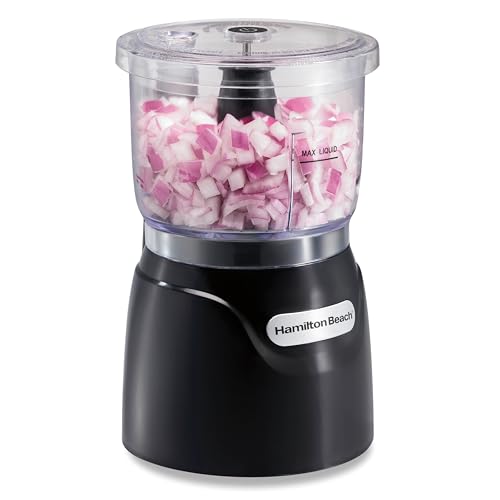
At 2.1 lb with a press-the-lid action, this is the least demanding machine to use of anything in this set.
Best for: one or two people chopping small amounts daily Skip it if: you slice or shred
This is the cheapest of the seven and the one buyers choose most often here. It is also the lightest at 2.1 lb, and the assembly is genuinely two steps. Hamilton Beach describes a patented stack and press design: you press the lid with your palm to run it and release to stop. There is no dial, no separate power button, and no twist-lock ring. For anyone with limited pinch grip, that matters more than any other feature in this article.
The 3-cup bowl handles an onion, a cup of nuts, a batch of hummus or a salad dressing. Hamilton Beach lists a 350-watt motor and stainless steel blades for onions, carrots and nuts. The bowl, lid and removable blades are all dishwasher safe, which removes the worst chore in the category.
Dimensions are 8.54 x 5.9 x 5.2 in, so it fits in a drawer or on a shelf without negotiation. Model 72850G, with a one-year warranty.
Where it loses is capability. There are no slicing or shredding discs, so cucumber rounds and shredded cheese are off the table entirely. Three cups also means repeat batches if you cook for four.
Pros:
- Lightest pick here at 2.1 lb
- Press-the-lid action needs no pinch grip
- Bowl, lid and blades all dishwasher safe
- Cheapest of the seven picks
- Fits a drawer at 8.54 x 5.9 x 5.2 in
Cons:
- No slicing or shredding disc at all
- 3 cups forces repeat batches for four people
- 350 watts is the second-weakest motor here
- No preset programs, so you judge texture yourself
3. Cuisinart Mini Food Processor — Best upgrade
Two push buttons, chop and grind, and a blade that reverses itself: the simplest control panel in the set.

Best for: grinding hard cheese and herbs in tiny batches Skip it if: you need more than 3 cups
This is the same 3-cup class as the Hamilton Beach above, at a middling price position, and it earns the step up on one design detail. Cuisinart lists a patented reversible stainless steel blade with an auto-reversing SmartPower action, giving two dedicated modes rather than one. The blunt edge grinds hard cheese and spices; the sharp edge chops herbs and vegetables. That is a real capability the cheaper chopper does not have.
Control is a push-button panel with two options. Nothing to interpret, nothing to hold at a precise pressure. The body is described as durable lightweight plastic with a brushed chrome finish, and the whole thing is 2.2 lb across 9.25 x 5 x 7 in.
The 24 oz bowl and the lid are dishwasher safe, and the motor base wipes clean with a damp cloth. Cuisinart lists it as BPA-free with an 18-month limited warranty, which is six months longer than either Hamilton Beach here. Motor is 250 watts, the lowest figure in this set.
Against the field it is the weakest motor and the smallest working volume, tied with the budget pick. It also costs more than the Ganiza 8-cup dual-bowl units while doing less.
Pros:
- Reversible blade gives separate chop and grind modes
- Two-button panel, nothing to interpret
- 18-month warranty beats both Hamilton Beach picks
- Only 2.2 lb across a 9.25 x 5 x 7 in footprint
Cons:
- 250 watts is the lowest motor figure here
- 3-cup bowl caps batch size
- Costs more than two larger dual-bowl picks
- No slicing or shredding discs included
4. Hamilton Beach 12 Cup Stack & Snap Food Processor and — Runner-up
The Big Mouth chute takes a whole potato, which removes the pre-cutting that knife work makes painful.

Best for: batch cooking without pre-cutting vegetables Skip it if: your storage is a high cabinet
This is the pick that solves a problem the small choppers cannot. Hamilton Beach says the Big Mouth chute fits a whole potato or tomato, cutting out the knife stage before processing. If gripping a knife is the hard part of cooking for you, that is worth more than any motor specification.
It also brings discs. The listing cites a chopping and pureeing blade plus a reversible stainless steel slicing and shredding disc, so shredded cheese and sliced cucumber are both possible here and impossible on picks 2 and 3. The 12-cup bowl is sealed in the centre, which Hamilton Beach says prevents leaks during processing. Suction cup feet are listed for countertop stability, which also helps with vibration.
At 6.57 lb it is the second-lightest of the four full-size machines, well under the 18 lb Cuisinart. Dimensions run 16.3 x 9.55 x 8.76 in, the tallest footprint in the set. Model 70725AG with a one-year warranty. It is the slowest seller of the seven.
The catch is the stack and snap assembly: more parts to align than any small chopper, and the discs mean a stem and a pusher to manage too. There are no preset programs.
Pros:
- Wide chute takes whole potatoes and tomatoes
- Slicing and shredding disc included, unlike both mini picks
- Sealed 12-cup bowl reduces leaks
- Suction feet steady it on the counter
- 6.57 lb, lighter than the 18 lb premium option
Cons:
- Most parts to assemble and align of any pick here
- 16.3 in tall, awkward under upper cabinets
- No preset programs to judge doneness for you
- Slowest seller in this set
5. Cuisinart Food Processor — Best premium
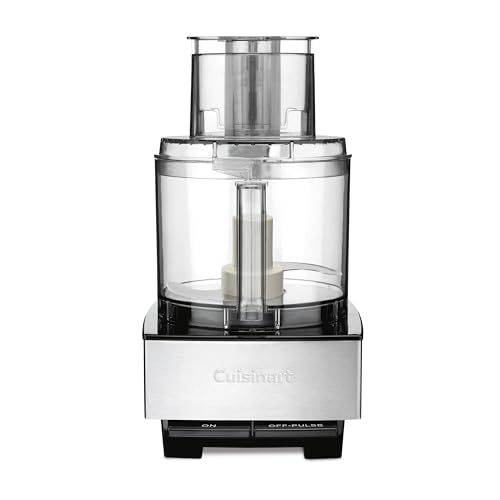
The longest published warranty here by a wide margin, in the heaviest body by a wider one.
Best for: a cook who leaves it on the counter permanently Skip it if: you have to move it at all
Eighteen pounds. That figure decides everything about this machine. It is more than twice the weight of the Ninja and roughly eight times the 2.1 lb Hamilton Beach chopper, and it is the reason this excellent processor sits at number five rather than number one for this reader. If it must come out of a cupboard before every meal, it is the wrong buy.
If it lives on the counter, it is the most capable pick here. The 14-cup bowl is the largest in the set. Cuisinart lists an extra-large feed tube with a bowl sleeve assembly and both small and large pushers, plus a 4mm stainless steel slicing disc, a medium shredding disc and a chopping and mixing blade, all dishwasher safe. The control layout is two buttons: on, and off/pulse. That simplicity is genuinely senior-friendly.
Warranty is the standout. Cuisinart states a limited 3-year warranty on the whole unit and a full 5-year warranty on the motor, the longest coverage published by anything here. Model DFP-14BCNY, 720-watt motor, 14.8 x 11 x 7.9 in, released 2018.
It is also the most expensive pick here, and Cuisinart notes the slicing and shredding blades are not adjustable.
Pros:
- Stated 3-year unit and 5-year motor warranty, longest here
- Largest bowl in the set at 14 cups
- Simple on and off/pulse control, no dial
- Slicing disc, shredding disc and chopping blade all included
- Extra-large feed tube with two pusher sizes
Cons:
- 18 lb, by far the heaviest pick and hard to move
- Most expensive of the seven
- Slicing and shredding discs are not adjustable
- No preset programs despite the price position
6. Ganiza Food Processors with 2 Bowls — Best for pros
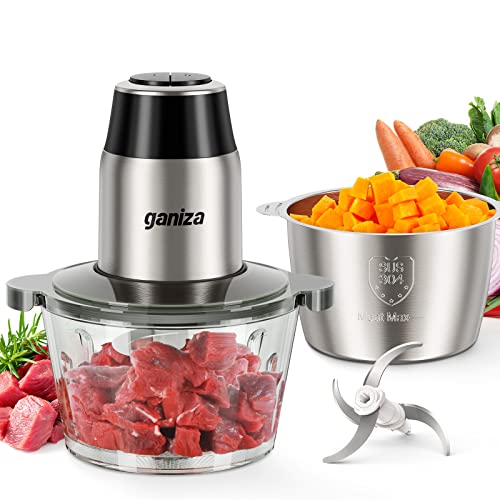
Two 8-cup bowls in one machine, so raw meat and fresh herbs never share a container.
Best for: grinding meat and chopping in separate bowls Skip it if: you want slicing discs or a warranty
The second-cheapest pick here has the most unusual configuration. Ganiza supplies two 8-cup bowls, one glass and one 304 stainless steel, plus two sets of blades. The company says the different materials exist specifically to stop confusion between bowls, which in practice means one for raw meat and one for everything else. If cross-contamination worries you, no other pick in this set solves it as directly.
Ganiza lists a 450-watt motor with two speeds and upgraded S-shaped stainless steel blades, described as suitable for meat grinding as well as vegetables. There is an overheating protection system, and Ganiza notes that if the machine stops you should let it cool for a few minutes before restarting. That is worth knowing before it happens. The base is 5 lb across 11 x 6.95 x 8.85 in, the lightest of the larger machines.
Two gaps stand out. This listing publishes no warranty term at all, unlike the Cuisinart and Hamilton Beach picks. And only one seller lists it, the narrowest availability in this set. It sits in the meat grinder category rather than food processors, which reflects what it is built for.
There are also no slicing or shredding discs, so this chops and grinds only.
Pros:
- Two 8-cup bowls, glass and 304 stainless steel
- Two blade sets and two speeds
- 5 lb, lightest of the larger machines
- Second-cheapest pick in the set
Cons:
- No warranty term published in the listing
- Only one seller lists it
- No slicing or shredding discs
- Overheat cutout means waiting mid-recipe
7. Ganiza Food Processor with Dual Bowls — Best minimal setup
The same dual-bowl idea with an upgraded press button, but the thinnest published specification sheet here.

Best for: a second bowl for raw and cooked food Skip it if: you want a published warranty
This is the newer sibling of pick 6, and the differences are worth understanding before you choose between them. Ganiza describes a patented upgraded button design for easier pressing, which is the one claim here that speaks directly to a senior buyer. It also adds an overheat protection light display, so the machine tells you it needs to cool rather than simply stopping.
The bowl arrangement matches: an 8-cup glass bowl and an 8-cup 304 stainless steel bowl, two blade sets, BPA-free construction and a full-copper motor Ganiza says lasts three times longer than a standard one. Model GC10-S, silver, 13 x 8 x 7 in.
Now the honest part. This listing gives no warranty term, no wattage figure, and a weight of 3.53 oz that cannot describe an 8-cup food processor. I will not guess at what it actually weighs, so if that number matters to your buying decision, ask before you order. It is also the slowest-selling pick of the seven, and it costs slightly more than the near-identical GC10 above while publishing less information.
Choose it over pick 6 for the easier button and the cooling indicator. Choose pick 6 if the 5 lb weight figure and the stated 450-watt motor matter more.
Pros:
- Upgraded press button aimed at easier operation
- Overheat protection with a light indicator
- Paired 8-cup glass and 8-cup stainless bowls
- BPA-free with full-copper motor claim
Cons:
- No warranty term published at all
- Listed weight of 3.53 oz is not usable information
- No wattage figure given, unlike every other pick
- Costs more than the near-identical GC10
- Slowest seller of the seven
One bowl or two: which setup is less work?
Two of these picks ship with paired bowls, and the pitch sounds convincing until you think about the sink.
The case for two bowls. You keep raw chicken in the stainless steel one and herbs in the glass one, permanently. No scrubbing between tasks, no worrying about garlic smell in a meat bowl. Ganiza builds both dual-bowl picks around exactly this logic, using two different materials so the bowls are impossible to mix up.
The case against. Two 8-cup bowls plus two blade sets is six components in your cupboard instead of three. Every extra part is another thing to identify, align and store. For a reader who wants fewer steps, that runs the wrong way.
My read: a single 9-cup or 12-cup bowl with dishwasher-safe parts is less work than two bowls you hand-manage, which is part of why the Ninja and the 12-cup Hamilton Beach rank above both Ganiza machines. Take the dual-bowl route only if raw meat is a regular job in your kitchen.
What the listings will not tell you about assembly
Product pages describe what a machine does. They rarely describe what you do. Here is what to check before you commit.
- Whether the bowl twist-locks. Hamilton Beach calls its system stack and snap, and the 3-cup version is a straight press. The Cuisinart 14-cup uses a bowl sleeve assembly. None of these listings states the force required, and that is the number you actually care about.
- How the lid interlocks. Most full-size processors will not start unless the lid is seated correctly, which is a safety feature and also the most common source of frustration.
- Whether discs need a stem. Slicing and shredding discs mount on a separate stem you must fit before the disc. That is two more parts on every use.
- What is dishwasher safe versus what is not. Hamilton Beach and Cuisinart both specify dishwasher-safe bowls, lids and blades. Both Ganiza listings say bowls are glass and stainless steel but do not confirm the same.
- Cord length and outlet position. Not published on any of these seven. Measure your counter run.
If you are buying for a parent rather than yourself, the single most useful thing you can do is assemble it once, then watch them do it unassisted before you leave.
The verdict
If you cook full meals and want the fewest decisions per use, buy the Ninja Professional Plus BN601. Its four Auto-iQ preset programs are the only one-touch controls in this set, and the 72 oz bowl and 7.65 lb base sit at a workable middle between the tiny choppers and the immovable 18 lb Cuisinart. It is the best quiet food processor for seniors in this group because it finishes the job fast and stops on its own.
If you only chop, buy the Hamilton Beach 3-cup. At 2.1 lb with a press-the-lid action and dishwasher-safe blades, it asks less of your hands than anything else here, and it is the cheapest pick.
The cutoff is discs. The moment you want sliced cucumber or shredded cheese, both 3-cup choppers are out, and the 12-cup Hamilton Beach becomes the answer at 6.57 lb with its whole-potato chute. Its exact advantage over the Ninja is that wide feed tube, which removes knife work entirely.
The 14-cup Cuisinart holds the longest published coverage here, a stated 3-year unit and 5-year motor warranty. Buy it only if it never has to move off the counter.
FAQ
Is a quiet food processor for seniors worth paying more for?
A quiet food processor for seniors is worth the extra outlay only when the premium buys usability, not decibels. None of these seven listings publishes a noise figure, so paying more for "quiet" buys you nothing verifiable. Paying more for the Ninja's four preset programs, or the Cuisinart's stated 5-year motor warranty, buys something you can actually check on the listing.
What size food processor is best for one or two people?
The best size for one or two people is 3 cups, which covers an onion, a cup of nuts, hummus or a dressing without leftovers sitting in the bowl. Both the 2.1 lb Hamilton Beach and the 2.2 lb Cuisinart Mini fit that brief and store in a drawer. Step to 9 or 12 cups only if you batch cook or freeze portions.
Ninja BN601 or Hamilton Beach 12 Cup: which should I choose?
Choose between the Ninja BN601 and the Hamilton Beach 12 Cup on knife work. The Ninja's four Auto-iQ presets mean you press once and walk away, and it holds 72 oz. The Hamilton Beach holds 12 cups and its wide chute swallows a whole potato, so you skip pre-cutting. Take the Ninja for simpler controls, the Hamilton Beach for less chopping by hand.
Does higher wattage make a food processor easier to use?
Higher wattage does not make a machine easier to use, only faster. These picks range from 250 watts to 1000 peak watts, and all of them chop vegetables. What changes the experience is lid design, button size and how many parts you align. A 250-watt Cuisinart Mini with two buttons is easier to operate than any high-wattage machine with a twist-lock bowl.
What is the most common mistake buying a food processor for seniors?
The most common mistake buying for an older cook is choosing on capacity. A 14-cup bowl looks generous until the 18 lb base has to come out of a low cupboard twice a day. Weigh the whole unit, count the assembly steps, and check whether the lid presses or twists. Then pick a size. Capacity should be your sixth consideration, not your first.
Start by measuring the shelf where the machine will actually live, then check the height and weight figures in the table against it. That one step eliminates most of this list for most kitchens. For a full-meal cook with a workable counter, the Ninja BN601 remains the default, and the reason is not its 1000 peak watts. It is that four preset buttons mean nobody has to stand over a running motor guessing whether the onion is done. That single change is what keeps an appliance in use rather than in a cupboard.