Best Large Food Processor: Ninja BN601 Leads

Seven large food processors compared on bowl capacity, wattage, footprint and weight, with a named winner and three conditions that flip the pick to something cheaper or smaller.

By Quinn BellUpdated 18 min read
On this page
- Best large food processor for students at a glance
- How I screened this shortlist of large food processors
- Does a large food processor actually suit a student kitchen?
- Wattage or bowl size: which number decides it?
- 1. Ninja Professional Plus Food Processor — Best overall
- 2. Cuisinart Food Processor DFP-14BCNY — Best premium
- 3. Ganiza Food Processors with 2 Bowls — Best budget pick
- 4. Hamilton Beach 12 Cup Stack & Snap Food Processor — Best for pros
- 5. Hamilton Beach Food Processor 70730 — Best minimal setup
- 6. Ganiza Food Processor with Dual Bowls — Runner-up
- 7. BLACK+DECKER Food Processor FP4200B-RF — Best for beginners
- What the listings don't tell you about storage and cleanup
- When a different pick wins
- The verdict
- FAQ
The best large food processor for students is the Ninja Professional Plus BN601, because its 72 oz bowl and 1000 peak watts handle a full week of batch prep in one pass. If your counter is narrower than 16 inches, the Ganiza GC10 at 11 x 6.95 x 8.85 in is the smarter buy. The number that splits this field isn't wattage. It's bowl volume against footprint, and the two rarely move together. A 14-cup Cuisinart weighs 18 lb; an 8-cup Ganiza weighs 5 lb. That gap decides more purchases than the motor does.
Best large food processor for students at a glance
| Pick | Bowl capacity | Footprint (W x D x H) | Price |
|---|---|---|---|
Best overall Ninja Professional Plus Food Processor |
72 oz (9 cup) | 16 x 9.88 x 7.76 in | Check Price |
Best premium Cuisinart Food Processor DFP-14BCNY |
14 cup | 14.8 x 11 x 7.9 in | Check Price |
Best budget pick Ganiza Food Processors with 2 Bowls |
8 cup + 8 cup | 11 x 6.95 x 8.85 in | Check Price |
Best for pros Hamilton Beach Stack & Snap 70725AG |
12 cup | 16.3 x 9.55 x 8.76 in | Check Price |
Best minimal setup Hamilton Beach Food Processor 70730 |
10 cup | 16 x 8.5 x 10 in | Check Price |
| 8 cup + 8 cup | 13 x 8 x 7 in | Check Price | |
Best for beginners BLACK+DECKER FP4200B-RF |
8 cup | 15.2 x 8.9 x 8.7 in | Check Price |



How I screened this shortlist of large food processors
I started with the published specifications, not the marketing. Seven machines survived, and the screen was simple.
- A stated bowl volume of 8 cups or more. Anything smaller is a mini chopper wearing a costume. That cut every 3-cup and 4-cup model immediately.
- A published footprint. If a listing doesn't tell you how much counter it eats, it's useless to anyone shopping for a small kitchen. All seven picks here publish dimensions.
- More than one processing function. Chopping alone isn't enough. Six of the seven include a slicing or shredding disc; the Ganiza pair swap that for a second bowl instead.
Two things I deliberately did not screen on. I ignored preset program counts, because a "dough" button does the same thing as holding the pulse. And I ignored motor claims stated in different units. The Ninja publishes 1000 peak watts. Hamilton Beach and BLACK+DECKER publish 450 watts. Cuisinart publishes 720 watts. Peak and continuous ratings aren't the same measurement, so lining them up in one column would flatter one brand and punish another.
What the screen left me with is a spread that runs from 5 lb to 18 lb and from 8 cups to 14. That range is the whole story of the best large food processor for students.
Does a large food processor actually suit a student kitchen?
Honestly, sometimes not. Amazon's results for the best large food processor for students return general kitchen machines, not anything built or specified for dorms, and no listing here mentions student use, hall regulations or dorm-safe wattage. So treat "for students" as your own filter rather than a promise on the box.
Three things you have to judge yourself:
- Counter depth. Four of the seven picks are 15 in wide or more. A standard dorm kitchenette run is often shorter than that once a kettle and a drying rack are in place.
- Cupboard height. The tallest here is 10 in (Hamilton Beach 70730). That clears most shelves, but check before you commit, because a processor that lives on the counter is a processor in the way.
- Shared washing up. A 14-cup bowl plus a lid plus two discs is four large items in a sink queue behind three flatmates.
Where a big machine genuinely earns its space is batch cooking. One session, 9 cups of chopped vegetables, six meals in the fridge. That maths works in a shared house far better than it does for one person cooking one portion. If you cook alone, most nights, from a single pan, a smaller chopper is the honest answer and I'd rather say so than sell you a 7.65 lb appliance.
Wattage or bowl size: which number decides it?
Most guides to the best large food processor for students lead with watts. It's the wrong lead. Wattage matters at the extremes, when you're kneading stiff dough or grinding raw meat, and almost nowhere else.
Bowl capacity is what you notice every single time you use the thing. Here's the ranking by stated volume:
- Cuisinart DFP-14BCNY: 14 cup
- Hamilton Beach 70725AG: 12 cup
- Hamilton Beach 70730: 10 cup
- Ninja BN601: 72 oz, which is 9 cups
- BLACK+DECKER FP4200B-RF: 8 cup
- Ganiza GC10 and GC10-S: 8 cup + 8 cup
Now weigh that against what the volume costs you. The Cuisinart holds the most and weighs 18 lb, more than triple the 5 lb Ganiza GC10. The Hamilton Beach 70725AG gets you 12 cups at 6.57 lb, which is the best volume-per-pound trade in the set and the reason it's here at all.
The real deciding criterion is this: pick the largest bowl you can lift comfortably with one hand while the other opens a cupboard. That's the test, because a processor you dread hauling out is a processor you stop using by week three. Everything above 10 lb in this set is a leave-it-on-the-counter machine. Everything under 7 lb is a put-it-away machine.
1. Ninja Professional Plus Food Processor — Best overall
The Ninja BN601 pairs the highest stated power figure in the set with a 72 oz bowl and a dough blade, at a footprint that still fits a normal counter run.
Best for: batch cooking on Sunday for the whole week Skip it if: your counter is under 16 inches wide
What separates this Ninja from the rest here is the combination, not any one number. The 72 oz bowl sits mid-pack on volume, behind the 14-cup Cuisinart and the 12-cup Hamilton Beach, but at 7.65 lb it's less than half the Cuisinart's 18 lb. That's the sweet spot I described above: big enough for real batch work, light enough to move.
Ninja states 1000 peak watts and four Auto-iQ preset programs covering chopping, slicing, pureeing and dough. The presets are the part I'd treat lightly. They automate timing you could do yourself with pulse, and no listing here quantifies what a preset changes. The dough blade is more interesting, because it's the only dedicated dough attachment stated in this entire shortlist. If bread or pizza base is part of your week, that's a genuine reason to choose this over the Hamilton Beach models.
It's also the newest here, released in 2020, with a 1-year warranty and a 16 x 9.88 x 7.76 in footprint. Grey only.
The trade-off is money and depth. It sits at the top of the price ladder alongside the Cuisinart, and at 16 in wide it's tied for the widest pick here. You pay premium position for 9 cups when the Cuisinart gives 14 and the 70725AG gives 12.
Pros:
- Highest stated power figure in this set, 1000 peak watts
- Only pick with a dedicated dough blade
- 72 oz bowl at just 7.65 lb
- Newest design here, released 2020
- Four preset programs for one-touch operation
Cons:
- Premium price position for a mid-pack 9-cup bowl
- 16 in wide, tied for the largest footprint
- 1-year warranty, shorter than the Cuisinart's stated coverage
- Grey is the only colour offered
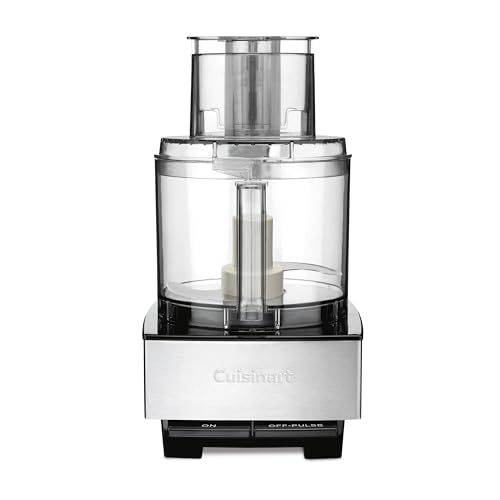
2. Cuisinart Food Processor DFP-14BCNY — Best premium
Fourteen cups and the longest stated warranty in the set, bought with 18 lb of countertop commitment.
Best for: a shared house cooking for four or more Skip it if: you'll need to move it in and out of a cupboard
The Cuisinart is the capacity champion here at 14 cups, five more than the Ninja and two more than the nearest Hamilton Beach. It's also the only pick whose listing spells out warranty terms in detail: Cuisinart states a limited 3-year warranty on the whole unit and 5 years on the motor. Every other pick here either states one year or states nothing at all.
Cuisinart lists a 720-watt motor, on/off and off/pulse buttons, an extra-large feed tube with a bowl sleeve assembly sized for both large and small pushers, and dishwasher-safe parts including a 4mm stainless slicing disc, a medium shredding disc and a chopping/mixing blade. The listing also flags something most brands bury: those slicing and shredding discs are not adjustable. One slice thickness, one shred size, no dial.
Then there's the weight. Eighteen pounds. That's heavier than the Ninja and the two Hamilton Beach picks combined. It's 14.8 x 11 x 7.9 in, so it's narrower than the Ninja but the deepest here at 11 in.
The trade-off is blunt. This is the most expensive pick and the one you will never put away. In a shared kitchen with contested counter space, that's a real cost.
Pros:
- Largest bowl here at 14 cups
- Longest stated warranty coverage in this set
- Dishwasher-safe parts including two discs
- Extra-large feed tube with dual pusher sizes
- Narrowest of the four large-footprint picks at 14.8 in
Cons:
- 18 lb, by far the heaviest pick here
- Slicing and shredding discs are fixed, not adjustable
- Deepest footprint in the set at 11 in
- Most expensive pick with no dough-specific attachment
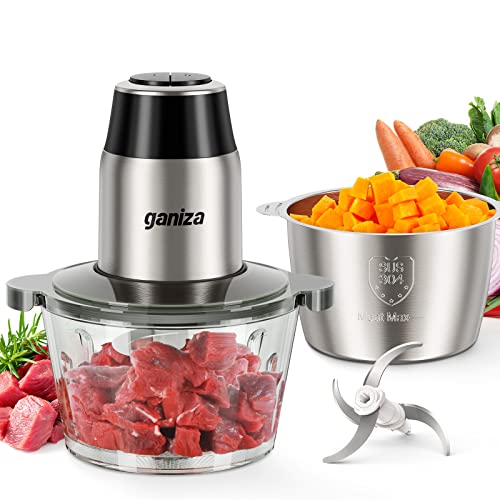
3. Ganiza Food Processors with 2 Bowls — Best budget pick
The cheapest pick here, the smallest footprint here, and the one buyers choose most often across this shortlist.
Best for: the smallest kitchen with the tightest spend Skip it if: you want slicing and shredding discs
At 11 x 6.95 x 8.85 in, the Ganiza GC10 takes up dramatically less counter than anything else here. It's 5 in narrower than the Ninja. In a kitchenette where the usable run is one arm's length, that difference is the whole decision.
Ganiza's approach to capacity is unusual. Instead of one big bowl you get two 8-cup bowls, one glass and one 304 stainless steel, plus two sets of S-blades. The stated logic is hygiene: keep raw meat in one bowl and vegetables in the other. Ganiza lists a 450-watt full-copper motor, two speeds, BPA-free construction and an overheat protection system, and the listing warns that if the machine stops you should let it cool for a few minutes before restarting. That warning tells you something the wattage doesn't. This isn't a machine for continuous heavy work.
It's also the fastest seller of the seven and the only pick where a single seller lists it. Weight is 5 lb, and it's categorised under meat grinders rather than food processors, which hints at where its strengths sit.
The trade-off is versatility. No slicing disc, no shredding disc, no feed chute. Chopping and grinding only.
Pros:
- Cheapest pick in this shortlist
- Smallest footprint here at 11 x 6.95 x 8.85 in
- Two separate 8-cup bowls, glass and stainless
- Sells faster than the rest of this set
- Light at 5 lb, easy to store
Cons:
- No slicing or shredding disc at all
- No feed chute for whole vegetables
- Cooldown pauses acknowledged in the listing
- No published warranty
- Only one seller lists it
4. Hamilton Beach 12 Cup Stack & Snap Food Processor — Best for pros
Twelve cups at 6.57 lb is the best capacity-to-weight ratio in this set, and the Big Mouth chute swallows whole vegetables.

Best for: chopping whole vegetables without pre-cutting Skip it if: you want preset programs to do the thinking
Run the numbers and this Hamilton Beach is the efficiency winner. Twelve cups of bowl for 6.57 lb of machine. The Cuisinart gives you two more cups for an extra 11.43 lb. If you're carrying this from a cupboard to a counter twice a week, that's not a close call.
Hamilton Beach describes a sealed 12-cup bowl designed to prevent leaks from the centre, a Big Mouth chute sized to take a whole potato or tomato without pre-cutting, a 450-watt motor, a chopping and pureeing blade, a reversible stainless slicing and shredding disc, and suction cup feet to stop it walking across the counter. The listing also suggests it as a pet food maker, which is a slightly odd flex but tells you the bowl is easy to fill and empty.
The Stack & Snap assembly is the headline. No twisting the bowl to find a locking notch. That matters more than it sounds when you're doing this half-asleep before a lecture.
It's the slowest seller of the seven and it sits high on the price ladder despite the 450-watt rating. That's the trade-off: you pay near the top for capacity and convenience, not for power.
Pros:
- 12 cups at only 6.57 lb, best ratio here
- Big Mouth chute takes whole potatoes and tomatoes
- Sealed bowl designed against centre leaks
- Reversible slicing and shredding disc included
- Suction feet for counter stability
Cons:
- Slowest seller of the seven picks here
- Priced near the top despite a 450-watt motor
- 16.3 in wide, the largest footprint in this set
- No preset programs, pulse control only
- One-year warranty only
5. Hamilton Beach Food Processor 70730 — Best minimal setup
A built-in bowl scraper you work while the motor runs, which is one less utensil in the sink.

Best for: someone who hates washing extra spatulas Skip it if: you regularly process more than 10 cups
The 70730 is the lightest of the four large-bowl picks at 6.2 lb, and it's the only machine here with a scraper built in. Hamilton Beach describes moving a lever side to side to scrape the bowl while processing, no stopping and no spatula. In a shared kitchen where washing up is a running argument, removing one item from the pile is worth more than a spec sheet suggests.
Specifications are straightforward: a 10-cup bowl, a 450-watt motor, two speeds plus pulse, a stainless slicing and shredding disc, five stated processing functions, a large feed chute to cut down on pre-chopping, and a one-year warranty. It's black and stainless, 16 x 8.5 x 10 in. That 10 in height is the tallest in the set, so measure your shelf.
Compared with its Stack & Snap sibling, you give up 2 cups of capacity and gain the scraper plus a slightly cheaper position. Compared with the Ninja, you give up the higher power rating and the dough blade.
The honest weakness is that 10 cups puts it fifth on capacity while sitting mid-range on price. You're paying for the scraper, and if you don't care about scraping, the value case thins out fast.
Pros:
- Only pick with a built-in bowl scraper
- Lightest large-bowl pick at 6.2 lb
- Two speeds plus pulse for fine control
- Large feed chute reduces pre-cutting
- Roughly mid-range price for this set
Cons:
- Tallest pick here at 10 in, may not clear a shelf
- 2 cups less capacity than its 70725AG sibling
- 450-watt motor, well below the Ninja's rating
- One-year warranty
- 16 in wide, no help in a narrow kitchen
6. Ganiza Food Processor with Dual Bowls — Runner-up
The second-cheapest pick here, with an overheat warning light and the same twin-bowl setup in a slightly wider body.

Best for: raw meat prep kept separate from vegetables Skip it if: you need a single big bowl instead of two
This is the GC10-S, the silver sibling of my budget pick, and the differences are small but real. It's 13 x 8 x 7 in, which makes it 2 in wider than the GC10 but the shortest machine here at 7 in tall. That's the pick for a low shelf.
Two features stand out in Ganiza's own description. First, an overheat protection light display, so the machine tells you it's cooling rather than leaving you to guess why it stopped. No other pick here publishes a status indicator. Second, an upgraded button design Ganiza calls patented and describes as easier to press. Treat that as a comfort claim rather than a measured one.
Otherwise it mirrors the GC10: two 8-cup bowls in glass and 304 stainless, two blade sets, a full-copper motor, two speeds, BPA-free construction.
It's second-cheapest and it sells faster than four of the picks here, but it's the strangest listing in the set. The stated count is 10 and the stated weight is 3.53 oz, which cannot describe a working food processor and almost certainly refers to a component. When a listing's own numbers contradict each other, that's a reason to be cautious, and it's why this sits sixth rather than third. Like the GC10, there are no slicing or shredding discs and no published warranty.
Pros:
- Second-cheapest pick in this shortlist
- Shortest machine here at 7 in tall
- Overheat status light, unique in this set
- Two 8-cup bowls in different materials
- Sells faster than four of these picks
Cons:
- Published weight and count are internally inconsistent
- No slicing or shredding disc
- No published warranty
- 2 in wider than the cheaper GC10
- No feed chute for whole produce
7. BLACK+DECKER Food Processor FP4200B-RF — Best for beginners
Lid-locking assembly and touchpad controls make this the least fiddly machine here to set up the first time.

Best for: a first food processor with nothing to figure out Skip it if: you want a published weight and warranty before buying
The FP4200B-RF solves the problem that makes people give up on food processors: the bowl that won't lock. BLACK+DECKER's design has you drop the work bowl onto the base and use the lid itself as the locking mechanism. One motion, no hunting for an alignment arrow.
The rest is a clean entry-level spec. An 8-cup work bowl, a 450-watt motor, a stainless S-blade, a reversible slice and shred disc, and easy-clean touchpad controls with low, high and pulse. The listing points at hummus, salsa and nut butter, which is a fair read of what an 8-cup bowl does well. It measures 15.2 x 8.9 x 8.7 in and comes in black.
Compared with the Ganiza pair it gains the reversible disc, which is the single most useful attachment a beginner can have. Compared with the Hamilton Beach models it loses 2 to 4 cups of capacity for a similar footprint, and that's the core problem here. You're giving up counter space you'd give up anyway for a bowl that's tied for smallest in the set.
The listing is also the thinnest here on hard data. No published weight, no published warranty, and its size is listed as "Large" rather than a figure. It's the slowest seller of the seven too.
Pros:
- Lid doubles as the locking mechanism, simple assembly
- Reversible slice and shred disc included
- Touchpad controls with low, high and pulse
- Entry-level price position
- Stainless steel S-blade
Cons:
- No published weight or warranty
- Tied for smallest bowl at 8 cups
- 15.2 in wide despite the small bowl
- Slowest seller in this set
- Size listed as "Large" rather than a measurement
What the listings don't tell you about storage and cleanup
Dimensions describe the assembled machine on a counter. They don't describe the pile of parts around it, and that's what a small kitchen actually has to absorb.
Count the components you'll be storing:
- Cuisinart DFP-14BCNY: base, 14-cup bowl, lid with feed tube, bowl sleeve, two pushers, slicing disc, shredding disc, chopping blade. Eight items.
- Ninja BN601: base, 72 oz bowl, lid, chopping blade, dough blade, discs. Six or more.
- Ganiza GC10: base, glass bowl, stainless bowl, two blade sets. Five items, and two of them nest.
Nothing in these listings tells you whether the parts stack inside the bowl for storage, so assume they don't and plan a drawer.
Cleanup is the other gap. Cuisinart is the only brand here that explicitly states dishwasher-safe parts. The others don't say either way. For anyone hand-washing in a shared sink, a discless machine like the Ganiza is genuinely faster to clean, because discs have a sharp edge on both sides and a hole in the middle. Also worth knowing: the Ganiza listings both flag a cooldown pause after heavy use. That's not a fault, it's a thermal cutout doing its job, but it means grinding two pounds of meat happens in stages rather than one go.
When a different pick wins
Three conditions flip my recommendation away from the Ninja, and all three are things you can check tonight with a tape measure.
- Your usable counter run is under 14 inches. Take the Ganiza GC10 at 11 in wide. The Ninja, both Hamilton Beach picks and the BLACK+DECKER are all 15 in or more.
- Your cupboard shelf is under 8.5 inches high. The GC10-S at 7 in is the only pick that clears comfortably. The 70730 at 10 in won't.
- You're cooking for four or more, regularly. The Cuisinart's 14 cups is worth the 18 lb, because the alternative is processing in two batches and washing the bowl in between.
One more flip, less about size. If bread dough is a weekly thing, the Ninja's dedicated dough blade is the only stated dough attachment in this shortlist, and that keeps it in front no matter how tight your counter feels. If you never make dough, that advantage evaporates and the 70725AG's 12 cups at 6.57 lb starts looking like the smarter buy for less counter commitment per cup.
The verdict
The Ninja Professional Plus BN601 is the best large food processor for students because it refuses to make you choose between capacity and portability. A 72 oz bowl handles a Sunday batch cook. At 7.65 lb, you can still lift it into a cupboard afterwards with one hand. Add the 1000 peak watt rating, the only dough blade in this set, and a 2020 design, and it's the pick I'd default to.
Two conditions change that. First, counter width. If you have less than 14 in of clear run, the Ganiza GC10 at 11 x 6.95 x 8.85 in is the only pick that genuinely fits, and it's the cheapest here as well as the fastest seller. You lose slicing and shredding discs entirely, which is a real sacrifice, but a machine that fits beats a machine that doesn't.
Second, household size. Cooking for four or more, the Cuisinart DFP-14BCNY's 14 cups saves you a second batch every single session, and its stated 3-year unit and 5-year motor warranty is the strongest coverage in this shortlist. The catch is 18 lb and an 11 in depth, so it lives on the counter permanently.
The runner-up's exact advantage over the Ninja is capacity plus warranty. Five more cups and years more coverage, paid for in weight.
FAQ
Is a large food processor worth it for one person?
A large food processor is worth it for one person only if you batch cook. Processing 9 cups of vegetables once beats chopping by hand six nights running. If you cook single portions from a single pan, an 8-cup model like the Ganiza GC10 at 11 in wide makes far more sense than a 14-cup, 18 lb machine.
What size food processor should students look for?
The size students should look for depends on counter space more than appetite. Between 8 and 12 cups covers almost everything a shared kitchen throws at it. The Hamilton Beach 70725AG delivers 12 cups at just 6.57 lb, which is the best capacity-per-pound trade in this set and the easiest large bowl to store between uses.
Ninja BN601 or Cuisinart DFP-14BCNY: which should I buy?
Choose between the BN601 and the DFP-14BCNY on weight. The Ninja gives 72 oz of bowl at 7.65 lb plus a dough blade, so it stores easily. The Cuisinart gives 14 cups and a stated 3-year unit, 5-year motor warranty, but weighs 18 lb and runs 11 in deep. Cooking for four or more, take the Cuisinart.
Does more wattage mean a better food processor?
More wattage doesn't mean a better food processor for everyday work. It matters for stiff dough and raw meat, not for chopping onions. Comparison is tricky here too: the Ninja states 1000 peak watts while Hamilton Beach and BLACK+DECKER state 450 watts continuous. Those are different measurements, so bowl capacity and footprint are far more reliable deciders.
What's the most common mistake buying a large food processor?
The most common mistake is buying on bowl capacity alone and ignoring height. The Hamilton Beach 70730 stands 10 in tall, which won't clear every kitchen shelf. Measure your cupboard opening and your clear counter run before you compare cup counts, because a processor that lives permanently in the way gets used far less often.
Measure two things before you order: the clear counter width and the shelf height where it'll live. Then match those numbers to the footprint column in the table above, and the choice usually makes itself. The Ninja BN601 stays my default because it's the one pick that doesn't force a compromise. Nine cups of working room, a dough blade nobody else here includes, and a body light enough at 7.65 lb that you'll actually put it away instead of resenting it. That last part is what separates an appliance you use from one you regret.