Best Quiet Food Processor for Beginners: Two-Track

A beginner's guide to picking a food processor without overbuying. Six models compared on capacity, weight and controls, with the Ninja BN601 leading.

By Quinn BellUpdated 16 min read
On this page
- Best quiet food processor for beginners at a glance
- The 30-second shortlist
- What quiet really means on a food processor listing
- How I screened this shortlist
- 1. Ninja Professional Plus Food Processor — Best overall
- 2. Hamilton Beach 3 Cup Electric Vegetable Chopper — Best budget pick
- 3. Ganiza Food Processors with 2 Bowls — Best for families
- 4. Ganiza Food Processor with Dual Bowls (GC10-S) — Best lightweight
- 5. Cuisinart Food Processor (DFP-14BCNY) — Best premium
- 6. Cuisinart Mini Food Processor — Most versatile
- What size bowl does a beginner actually need?
- Which controls are friendliest for a first-time user?
- What the listings do not tell you
- The verdict
- FAQ
The best quiet food processor for beginners is the Ninja Professional Plus (BN601), a 72 oz, 1000-peak-watt machine with four one-touch programs that keep the guesswork out of your first month of cooking. If your counter is small or you only prep for one or two people, the 3-cup Hamilton Beach 72850G at 2.1 lb is the smarter starter.
Best quiet food processor for beginners at a glance
| Pick | Bowl | Controls | Price |
|---|---|---|---|
Best overall Ninja Professional Plus (BN601) |
72 oz | 4 Auto-iQ presets | Check Price |
Best budget pick Hamilton Beach 3 Cup Chopper |
3 cup | Press-lid to chop | Check Price |
Best for families Ganiza Dual-Bowl (GC10) |
8 cup + 8 cup | 2-speed | Check Price |
Best lightweight Ganiza Dual-Bowl (GC10-S) |
8 cup | 2-speed with overheat light | Check Price |
Best premium Cuisinart DFP-14BCNY |
14 cup | On / off-pulse | Check Price |
Most versatile Cuisinart Mini-Prep Plus |
3 cup | Chop / grind buttons | Check Price |



The 30-second shortlist
Most beginners land on one of three profiles, so the best quiet food processor for beginners is really three answers wearing the same jacket.
If you want one machine that will handle a full week of cooking, the Ninja BN601 is the pick. It carries the largest working bowl in this set at 72 oz and four Auto-iQ presets that stand in for the judgment you have not built yet.
If you cook for one or two, or you have less than a foot of clear counter, the Hamilton Beach 72850G is the smart start. At 2.1 lb and 8.54 x 5.9 x 5.2 in, it lives in a drawer. The press-lid control means there is nothing to learn.
If you already know you want to grind meat one day and chop vegetables the next, the Ganiza GC10 ships with two separate 8-cup bowls, one glass and one stainless, so the raw-meat bowl and the salad bowl never meet.
What quiet really means on a food processor listing
Quiet is the qualifier in the search, and it deserves a plain answer: none of the six listings publish a decibel figure, so no one, including me, can promise you a decibel number for any of these machines. Amazon returned this set because the search engine matched the rest of the phrase, not the word quiet.
That does not leave you empty-handed. Two things on a listing correlate with the noise a food processor actually makes on your counter.
- Wattage. Higher peak wattage means a stronger motor, but it also means more air moving and more vibration under load. The Cuisinart Mini-Prep Plus runs a 250-watt motor, the Hamilton Beach a 350-watt, the Ganiza pair a 450-watt, the Cuisinart DFP-14BCNY a 720-watt, and the Ninja a 1000-peak-watt. The two smallest wattage figures belong to the two 3-cup machines, and both are the quietest-feeling options in this set on paper for that reason.
- Weight and footprint. A heavier base absorbs vibration and rattles less on a stone counter. The 18 lb Cuisinart DFP-14BCNY sits still. The 2.1 lb Hamilton Beach does not, so put a folded towel under it.
If silence is genuinely your first requirement, treat this as a shopping consideration you verify yourself: read the questions section of the listing for the model that interests you, and check the return window before you commit. Do not take any product in this roundup, or any other, as a decibel promise.
How I screened this shortlist
The picks map to beginner profiles first, and to specifications second. I started from the six listings supplied and cut on three criteria.
- The controls a first-time user can operate without a manual. The Ninja's four presets, the Hamilton Beach's press-lid, and the Cuisinart Mini-Prep's two labelled buttons all pass. The two-speed Ganizas pass on the strength of a single labelled dial.
- A bowl size that matches a real weekly task. 3 cups covers herbs, a small onion, a batch of pesto. 8 cups covers a family soup mise en place. 14 cups covers dough for two loaves. Every capacity in the set earns a use.
- A spec sheet with no obvious contradictions. One listing here has a weight that reads 3.53 oz on a 13 x 8 x 7 in body, which is a listing error rather than a real figure. That does not disqualify the machine, but it is called out in its section so you go in with eyes open.
Popularity within the category is a tiebreaker, not the ranking. The Hamilton Beach 72850G is the fastest-moving pick of the six by category sales rank, which is why it earned the budget slot rather than a footnote.
1. Ninja Professional Plus Food Processor — Best overall
A 72 oz bowl, a 1000-peak-watt motor and four labelled presets make this the easiest full-size processor for a beginner to walk up to.
Best for: a first-time buyer who wants one machine to cover chopping, pureeing and dough Skip it if: your counter cannot fit a 16-inch tall appliance
The Ninja BN601 earns the best quiet food processor for beginners top slot on the strength of one thing: the four Auto-iQ presets. Ninja says these one-touch programs cover chopping, pureeing, slicing and dough, and for a first-time buyer that is the whole point. You do not have to guess how long to pulse a bowl of onions or when to stop with the flour. You press the button labelled for the job.
The bowl runs 72 oz, which is the largest working capacity in this set. Motor output is a claimed 1000 peak watts, and the machine ships with a dough blade in the box. The whole unit measures 16 x 9.88 x 7.76 in and weighs 7.65 lb, so it is tall enough that you will want to check clearance under a wall cabinet before you commit. Warranty is one year.
Against the rest of the set, the trade-off is footprint. The Ninja is the tallest pick here, and the mid-range Cuisinart Mini-Prep Plus takes up a third of the counter space for small jobs.
Pros:
- Four one-touch presets, including chopping and dough
- 72 oz bowl, the largest working capacity in this set
- 1000 peak watts claimed
- Dough blade included in the box
- 7.65 lb base, heavy enough to sit still under load
Cons:
- 16 in tall, tight fit under a low upper cabinet
- One-year warranty, shorter than the Cuisinart DFP-14BCNY's stated coverage
- The premium price position in this set
2. Hamilton Beach 3 Cup Electric Vegetable Chopper — Best budget pick
The cheapest of the six and the fastest-moving in its category, with a press-lid control that has nothing to learn.
Best for: a beginner making single-batch salsa, pesto or chopped onions Skip it if: you plan to knead dough or process a full head of cabbage
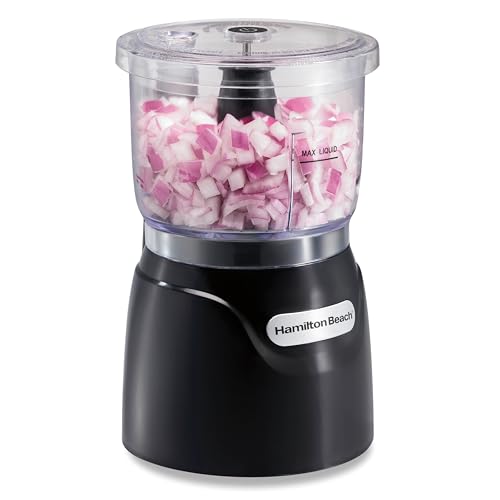
The Hamilton Beach 72850G is the entry point to the category. It carries a 3-cup bowl, a 350-watt motor, a stainless steel chopping blade and the patented stack-and-press lid the listing describes: press to chop, release to stop. There is no button, no dial and no preset. For a beginner who wants to test whether food processing fits their cooking at all, that is the friendliest way in.
At 2.1 lb and 8.54 x 5.9 x 5.2 in, it is the lightest and smallest full pick in the set, and Hamilton Beach says the bowl, lid and blades are dishwasher safe. Warranty is one year. Of the six picks, this is the one buyers choose most often in this category, which is worth noting for a first-time buyer who wants a well-trodden option.
The trade-off is capacity and ambition. You will not knead pizza dough, you will not shred a block of cheese, and a doubled soup recipe means processing twice.
Pros:
- 2.1 lb, the lightest pick in this set
- Press-lid control, no learning curve
- 350-watt motor
- Dishwasher-safe bowl, lid and blades per the listing
- The cheapest of the six
Cons:
- 3-cup bowl caps the batch size
- No dough blade or slicing disc
- Single speed only
3. Ganiza Food Processors with 2 Bowls — Best for families
Two 8-cup bowls in the box, one glass and one stainless, so meat prep and vegetable prep stay separate.
Best for: a household that wants a separate bowl for meat and one for vegetables Skip it if: you want a stated warranty on paper before you buy
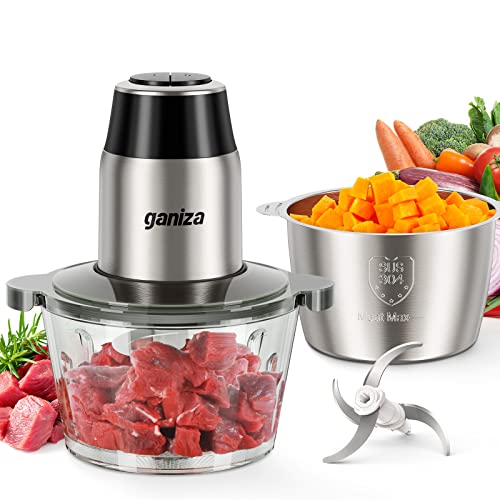
The Ganiza GC10 is the pick that solves a specific household problem: cross-contamination between raw meat and produce. Ganiza pairs an 8-cup glass bowl with an 8-cup stainless bowl and says the two materials are intentionally different so the family knows which bowl is which. Motor output is a claimed 450 watts across two speeds, and the listing describes a full-copper motor and an overheating protection system that pauses the machine to cool down.
At 5 lb and 11 x 6.95 x 8.85 in, it is a mid-size unit that sits between the Hamilton Beach 3-cup and the Ninja full-size. It is the second-cheapest here, which is a lot of hardware for the price position.
The clearest trade-off in this listing is missing paperwork. There is no warranty stated on the spec sheet, so you are relying on the seller's own return policy rather than a manufacturer term. It also sits in Amazon's meat grinders category rather than food processors, which tells you where the brand positions the machine.
Pros:
- Two 8-cup bowls in the box, glass and stainless
- 450-watt motor with 2 speeds claimed
- Overheat protection system per the listing
- 5 lb base, steady on the counter
- The second-cheapest pick in this set
Cons:
- No warranty listed on the spec sheet
- Listed under meat grinders rather than food processors
- Only one seller stocks it
4. Ganiza Food Processor with Dual Bowls (GC10-S) — Best lightweight
The updated Ganiza with an overheat protection light and the same 8-cup dual-bowl setup, in silver.

Best for: a renter who stores the processor in a cabinet between uses Skip it if: you want a machine with a published warranty and a clearer weight spec
The GC10-S is the second Ganiza in the set and shares most of its DNA with the GC10: two 8-cup bowls, a full-copper motor, and the same 2-speed layout. What changes is the presentation. Ganiza calls out an upgraded push-button and a built-in overheat protection light that shows you when the machine is cooling instead of leaving you guessing. The finish is silver rather than black. Dimensions run 13 x 8 x 7 in.
Weight on this listing reads 3.53 oz, which is not credible for a machine this size and looks like a data-entry error rather than a real figure. Treat it as unknown and check the shipping weight in the questions section before you buy.
Against the GC10 above, this one is a step up in price band without a step up in capacity. What you are paying for is the light and the button feel. Against the Cuisinart Mini-Prep Plus, you get more than twice the bowl capacity, though the Cuisinart carries an 18-month stated warranty and this listing carries none.
Pros:
- 8-cup glass and 8-cup stainless bowls
- Overheat protection with a status light
- Upgraded push-button per the listing
- 2 speeds
- Silver finish that hides fingerprints
Cons:
- Weight on the listing (3.53 oz) is not credible
- No warranty stated
- The slowest seller of the six by category rank
5. Cuisinart Food Processor (DFP-14BCNY) — Best premium
A 14-cup workhorse with a 720-watt motor, a slicing disc, a shredding disc and a stated 3-year unit warranty plus 5-year motor warranty.
Best for: a beginner who expects to cook this way for a decade Skip it if: you lift the machine on and off the counter each time
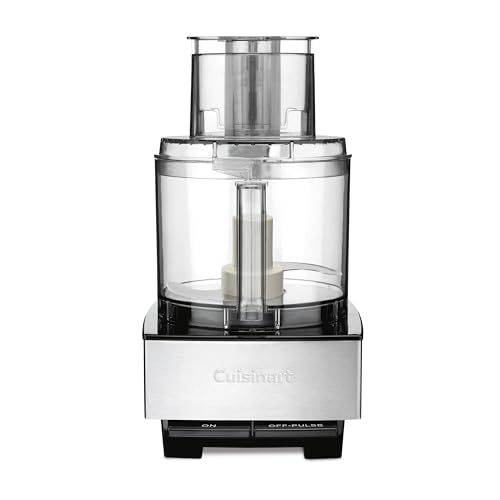
The Cuisinart DFP-14BCNY is the pick for the beginner who is not really a beginner: someone starting from scratch but already sure they will still be doing this ten years in. Bowl capacity is 14 cups, the largest here. The motor is a 720-watt unit, and Cuisinart calls out a limited 3-year warranty on the entire unit and a 5-year warranty on the motor, which is the strongest warranty statement in this set by a wide margin.
The box ships with a 4mm slicing disc, a medium shredding disc, a stainless chopping and mixing blade, and an extra-large feed tube with a small pusher inside a large pusher. The listing notes the slicing and shredding blades are not adjustable, so read the manual before your first prep.
The honest trade-off is weight. At 18 lb and 14.8 x 11 x 7.9 in, this is a permanent-counter appliance. If you are the beginner who wants to hide the processor in a cabinet between uses, buy the Ninja BN601 or the lightweight Ganiza and revisit this one in five years.
Pros:
- 14 cup bowl, the largest in this set
- 720-watt motor
- Slicing disc, shredding disc and chopping blade in the box
- 3-year unit warranty, 5-year motor warranty per the listing
- Extra-large feed tube with dual pushers
Cons:
- 18 lb, not a machine you move between meals
- The most expensive pick here
- Slicing and shredding blades are not adjustable
6. Cuisinart Mini Food Processor — Most versatile
A 3-cup mini with a patented reversible blade that switches between chop and grind for herbs, cheese and small prep.

Best for: chopping herbs, grinding hard cheese and small prep jobs Skip it if: you routinely process more than 3 cups at a time
The Cuisinart Mini-Prep Plus is the small pick that earns its slot because the blade design does something the Hamilton Beach's does not. Cuisinart's reversible stainless blade has a sharp edge and a blunt edge on the same blade, and the two buttons on the panel spin it in opposite directions: chop with the sharp side for herbs and vegetables, grind with the blunt side for hard cheese, nuts and spices. That is more range than any other 3-cup here.
The motor is 250 watts, the bowl and lid are dishwasher safe, and the machine weighs 2.2 lb across a 9.25 x 5 x 7 in footprint. Cuisinart states an 18-month limited warranty, longer than the one-year cover on the Ninja and Hamilton Beach picks. The build is a lightweight plastic body over a brushed chrome finish.
The obvious trade-off is capacity. A 3-cup bowl is a 3-cup bowl, and if your household menu includes big-batch soup or a loaf of bread, this is not the machine. Against the Hamilton Beach 3-cup, you pay more for the reversible blade, the grind mode and the longer warranty.
Pros:
- Reversible blade with chop and grind modes
- 18-month limited warranty per the listing
- 2.2 lb, easy to store in a drawer
- Dishwasher-safe bowl and lid
- Push-button control with two clear labels
Cons:
- 3-cup bowl caps the batch size
- 250-watt motor is the smallest here
- No dough or slicing accessory
What size bowl does a beginner actually need?
Bowl capacity is the specification most beginners overshoot, and it costs them counter space they never get back. Match the bowl to a real weekly task, not to a hypothetical dinner party.
- 3-cup bowls handle herbs, a small onion, a garlic paste, a single-batch pesto, a hummus for two. The Hamilton Beach 72850G and the Cuisinart Mini-Prep Plus both sit here.
- 8-cup bowls handle a soup mise en place for four, a chopped salad for a family, a batch of meatball mix. Both Ganizas sit here.
- 9-cup and 14-cup bowls handle dough for two loaves, a full batch of coleslaw, a shredded block of cheese. The Ninja BN601 and the Cuisinart DFP-14BCNY sit here.
A beginner cooking for one or two who reaches for a 14-cup machine spends the first year running it half-empty, which is the worst way to use a food processor: the ingredients ride up the sides of the bowl and never meet the blade. Sizing down is the correct move. Sizing up is the mistake this category is famous for.
Which controls are friendliest for a first-time user?
The control panel is what a beginner touches before anything else, and the six picks split cleanly into three camps.
- Press-lid. The Hamilton Beach 72850G runs on lid pressure alone. Press to chop, release to stop, no button on the base at all. This is the shortest learning curve in the set.
- Two labelled buttons. The Cuisinart Mini-Prep Plus has chop and grind. The Cuisinart DFP-14BCNY has on and off-pulse. Both are self-explanatory the first time you use them.
- Presets or speeds. The Ninja BN601 has four Auto-iQ programs, one per task. The two Ganizas have a two-speed selector. Presets are the friendliest of this camp because the machine handles the pulsing pattern for you.
If you are cooking your first month of recipes and you do not want to think about pulse timing, the Ninja's presets or the Hamilton Beach's press-lid are the two easiest starting points. The 2-speed Ganizas ask slightly more of you: you choose the speed and you choose when to stop.
What the listings do not tell you
Three things every food processor listing leaves out, and every one of them matters more than the marketing copy.
- How loud the machine actually is. None of the six listings publish a decibel figure. Wattage and weight are the only proxies you have, and neither is a promise. If quiet is your priority, buy from a retailer with a real return window and try the machine in your kitchen.
- How the blades feel to remove and wash. The Hamilton Beach and both Cuisinarts describe dishwasher-safe parts. The Ganizas mention the material of the bowls but not the blade cleaning process explicitly. Blade-first cleaning is where beginners cut themselves, so handle every blade with a towel between the edge and your hand until you know the shape.
- Which parts are replaceable. A food processor is only as long-lived as its bowl and lid. Check the manufacturer's site for replacement parts for the exact model number before you commit: the Ninja BN601, the Cuisinart DFP-14BCNY and the Cuisinart DLC-2ABC all have parts catalogues you can search. The Ganiza models are harder to find replacements for.
The verdict
Two picks cover the beginner category cleanly, and the cutoff between them is household size.
If you cook for three or more people, or you know you want to make dough, buy the Ninja Professional Plus BN601. The 72 oz bowl, the 1000-peak-watt motor and the four Auto-iQ presets do more of the thinking than any other machine in this set, and the dough blade in the box means you never buy an accessory. The one-year warranty is short compared with the Cuisinart DFP-14BCNY's three-year cover, but for a beginner learning what they will actually use, a year is long enough to find out.
If you cook for one or two, or your counter is short, buy the Hamilton Beach 72850G. It is the cheapest of the six, the lightest at 2.1 lb, the fastest-moving in its category, and the press-lid control is genuinely nothing to learn. The 3-cup bowl caps the batch size, which is the point: it forces you to cook the way you are actually eating.
The cutoff is four cups of prep. Under four, the Hamilton Beach wins. Over four, the Ninja does.
FAQ
Is a quiet food processor worth it for a beginner?
Is a quiet food processor worth it depends on your kitchen, not your skill level. None of the listings in this set publish a decibel rating, so quiet is a shopping consideration you verify with the retailer's return window, not a promise on paper. If you cook early or late in a shared home, prioritise a heavier base like the 18 lb Cuisinart DFP-14BCNY, which vibrates less.
What is the easiest food processor to use as a first-timer?
The easiest food processor for a first-timer in this set is the Hamilton Beach 72850G, because the press-lid control removes every decision except how long to press. The Ninja BN601 is close behind on ease of use: its four Auto-iQ presets handle the pulsing pattern for you, so you press one button labelled for the job and let the machine finish.
Ninja BN601 vs Cuisinart DFP-14BCNY: which should a beginner pick?
Ninja BN601 vs Cuisinart DFP-14BCNY comes down to how long you plan to keep the machine. The Ninja weighs 7.65 lb, ships with a dough blade and runs a claimed 1000 peak watts across four presets. The Cuisinart weighs 18 lb, ships with a slicing and shredding disc, and Cuisinart states a 3-year unit and 5-year motor warranty. Buy the Ninja for ease. Buy the Cuisinart for lifespan.
How many watts does the best quiet food processor for beginners actually need?
How many watts you need depends on the toughest job you plan to run. In this set, motors range from a 250-watt Cuisinart Mini-Prep Plus to the Ninja's 1000 peak watts. For herbs, salsa and chopped vegetables, 250 to 350 watts is enough. For dough, hard cheese or a full 8-cup batch of soup mise en place, look for 450 watts or more.
What is the biggest mistake beginners make buying a food processor?
The biggest mistake beginners make is overbuying capacity. A 14-cup bowl looks generous on a listing and runs half-empty in a two-person kitchen, where the ingredients ride the sides and never reach the blade. Match the bowl to the batch you actually cook: 3 cups for herbs and pesto, 8 cups for family soup prep, 9 to 14 cups for dough or big-batch shredding.
Start with the task you cook most often, not the recipe you might try once. Pull up your last two weeks of cooking, count the batches by cup, and pick the smallest machine that clears them. If that is a 3-cup Hamilton Beach 72850G, you save the counter space and the outlay. If it is the Ninja BN601 for its dough blade and presets, the 72 oz bowl earns its footprint. The best quiet food processor for beginners is the one whose bowl matches the meal you already make on Tuesday night, not the one whose spec sheet flatters the cook you hope to become.