Best Mini Food Processor: Hamilton Beach Leads
A ranked comparison of seven compact choppers, from a 2.1 lb 3-cup Hamilton Beach to a 5 lb twin-bowl Ganiza. Which one earns counter space, and which specification actually decides it.

By Quinn BellUpdated 20 min read
On this page
- Best mini food processor for daily use at a glance
- How I screened these seven listings
- Does bowl size actually decide it?
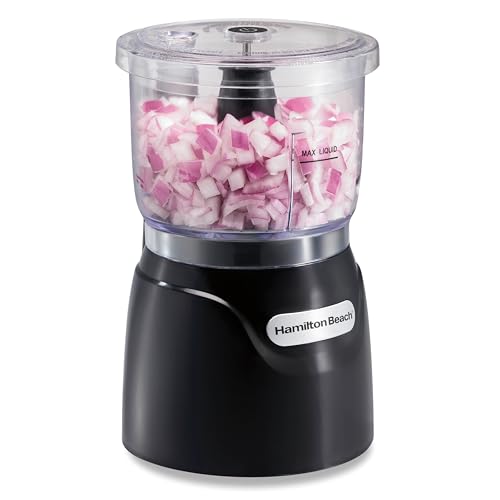
- 1. Hamilton Beach 3 Cup Electric Vegetable Chopper & Mini — Best overall
- 2. Ganiza Food Processors with 2 Bowls — Most versatile
- 3. Cuisinart Mini Food Processor — Best for beginners
- 4. La Reveuse Electric Food Processor — Best for families
- 5. Cuisinart Small Food Processor — Best premium
- 6. SHARDOR Food Chopper, 4 Cup Mini and Fast Food Processor — Best upgrade
- 7. TTFTTF Electric Garlic Chopper — Best for heavy use
- What the wattage number hides
- Glass or plastic bowl: which suits your routine?
- What owning one actually involves
- When a different pick wins
- The verdict
- FAQ
The best mini food processor for daily use is the Hamilton Beach 72850G, a 3-cup chopper that weighs 2.1 lb and runs a 350 watt motor, which is more power than two pricier picks here. If you grind meat as often as you chop vegetables, the twin-bowl Ganiza GC10 takes over. Most shoppers compare wattage figures and stop there. That is the wrong first move, because a 450 watt motor spinning an 8-cup bowl does less useful work on a single onion than 350 watts spinning three cups.
Best mini food processor for daily use at a glance
| Pick | Bowl capacity | Motor | Price |
|---|---|---|---|
| 3 cups | 350W claim | Check Price | |
Most versatile Ganiza Food Processors with 2 Bowls |
8 cups + 8 cups | 450W claim | Check Price |
Best for beginners Cuisinart Mini Food Processor |
3 cups | 250W claim | Check Price |
Best for families La Reveuse Electric Food Processor |
7 cups | 300W claim | Check Price |
Best premium Cuisinart Small Food Processor |
4 cups | 120V, not stated | Check Price |
| 4 cups | 400W claim | Check Price | |
Best for heavy use TTFTTF Electric Garlic Chopper |
350 ml | 40W claim | Check Price |


How I screened these seven listings
I lined up the published specifications side by side and let the gaps do the sorting. Four numbers mattered: bowl capacity, motor wattage as claimed by the brand, unit weight, and whether a warranty term appears at all.
That last one cut deeper than expected. Only four of these seven listings publish a straightforward warranty length. Hamilton Beach states one year, La Reveuse states one year against manufacturer's defects, and both Cuisinart models state 18 months. The Ganiza listing publishes no warranty term. The SHARDOR listing publishes none either. The TTFTTF listing fills its warranty field with charging instructions instead, which tells you something about how carefully that page was assembled.
Weight was the second filter. A machine you lift out of a cupboard every evening is a different object from one you lift out twice a month:
- Hamilton Beach 72850G: 2.1 lb
- Cuisinart DLC-2ABC: 2.2 lb
- Cuisinart ECH-4SV: 2.65 lb
- TTFTTF F3: 1.5 lb
- Ganiza GC10: 5 lb
Two listings, La Reveuse and SHARDOR, publish dimensions but no weight. I have not guessed at those, and I have not held it against them beyond noting the blank.
Popularity was the tiebreaker, not the criterion. Among these seven, the Hamilton Beach is the one buyers choose most often, with the Ganiza next. The SHARDOR sells slowest of the group by a wide margin.
Does bowl size actually decide it?
Bowl size decides more than wattage does, and it decides it in an unintuitive direction. A bigger bowl is not a better bowl for a mini processor.
Here is the mechanics of it. Blades sit at the bottom of the bowl and throw ingredients outward. In a 3-cup bowl, an onion has nowhere to hide from the blade path. In an 8-cup bowl, the same onion spreads across a wide floor and half of it never crosses the blade. You end up pulsing longer, scraping the sides, and finishing with a mix of paste and chunks.
So the useful question is not "how much can it hold" but "what is the smallest batch it still handles well". A 3-cup bowl works well from about half a cup upward. A 7-cup or 8-cup bowl wants to be at least a third full to chop evenly, which means two cups of material minimum.
That is why the best mini food processor for daily use in this set is a 3-cup machine rather than an 8-cup one. Two cloves of garlic and a small handful of parsley is a realistic Tuesday. Three cups of diced carrot is a Sunday project.
The range here spans a genuine 20x:
- TTFTTF F3: 350 ml, roughly a cup and a half
- Hamilton Beach and Cuisinart DLC-2ABC: 3 cups
- Cuisinart ECH-4SV and SHARDOR: 4 cups
- La Reveuse: 7 cups
- Ganiza: 8 cups plus a second 8-cup bowl
Pick your usual batch, then buy the bowl that is a little larger than it. Not four times larger.
1. Hamilton Beach 3 Cup Electric Vegetable Chopper & Mini — Best overall
A 3-cup bowl, a 350 watt motor and the lightest full-size body here at 2.1 lb make this the default choice for nightly chopping.
Best for: small-batch cooks who chop onions and herbs most nights Skip it if: you regularly process more than 3 cups at once
Three things separate this from the rest of the set. It is the cheapest of the seven. It carries more claimed wattage than either Cuisinart, at 350 watts against 250 watts for the DLC-2ABC. And at 2.1 lb it is the lightest of the corded machines, which matters when the unit lives in a cupboard.
The control scheme is the reason I'd start here. Hamilton Beach calls it stack and press: you press the lid to chop and release to stop. There is no button to find, no speed to choose. Press for a second, look, press again. That is precisely the interaction you want when you're chopping half an onion with a pan already heating.
Footprint is 8.54 x 5.9 x 5.2 in, which is the shortest height of any pick here. It clears most under-cabinet gaps without tipping the base. The brand states the bowl, lid and removable blades are all dishwasher safe, and the blades come out rather than staying fixed in the bowl floor.
The trade-off is capacity. Three cups is the smallest corded bowl in this group alongside the DLC-2ABC, and there is one speed only. If you want texture control between coarse salsa and fine paste, the two-speed picks give you a lever this does not.
Pros:
- Cheapest of the seven picks
- 350 watts claimed, more than either Cuisinart
- Lightest corded body at 2.1 lb
- Press-the-lid control needs no button hunting
- One year warranty published
Cons:
- Single speed, no coarse-versus-fine control
- 3-cup bowl is the joint smallest corded option
- Plastic bowl rather than glass
- One year is the shortest published warranty here
2. Ganiza Food Processors with 2 Bowls — Most versatile
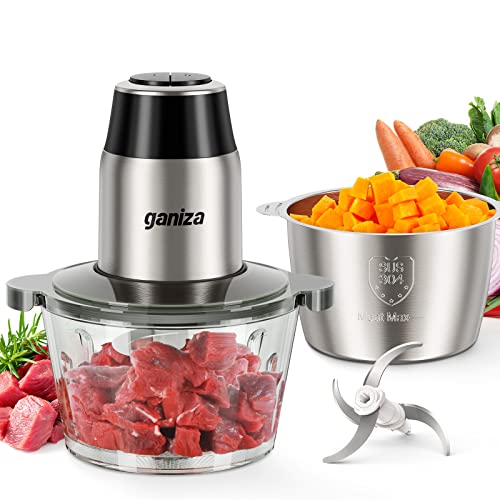
Two 8-cup bowls, one glass and one stainless steel, plus 450 claimed watts make this the only pick here that separates meat prep from vegetable prep.
Best for: cooks who grind meat and chop vegetables in the same session Skip it if: counter and cupboard space is tight
Nobody else in this group ships two bowls. Ganiza pairs an 8-cup glass bowl with an 8-cup stainless steel bowl, each with its own blade set, and the listing is explicit about why: different materials so you don't confuse the raw-meat bowl with the salad bowl. If you grind your own burger meat, that separation is worth more than any wattage figure.
At 450 claimed watts it also carries the highest motor number here. Ganiza describes a full-copper motor and says it supports three times the service life of a regular motor, which is the brand's claim rather than a measured figure. Two speeds give you pulse control, and the listing notes an overheating protection system that stops the machine and needs a few minutes to cool.
The cost is bulk. This weighs 5 lb, more than double the Hamilton Beach, and measures 11 x 6.95 x 8.85 in before you find somewhere for the spare bowl. It also sits in the meat grinder category rather than food processors, which is a fair reflection of where its strength is.
Two blanks on the listing bother me: no published warranty term at all, and no stated stainless grade beyond the 304 mentioned for the bowl. For a machine you'd use daily, a warranty line would reassure.
Pros:
- Only pick with two bowls and two blade sets
- 8-cup glass plus 8-cup stainless steel keeps raw meat separate
- Highest claimed wattage of the seven, at 450W
- Two speeds plus stated overheating protection
- Second-most-chosen pick here by buyers
Cons:
- Heaviest at 5 lb, and needs storage for a spare bowl
- No warranty term published on the listing
- 8-cup bowls chop small handfuls unevenly
- Only one seller lists it
3. Cuisinart Mini Food Processor — Best for beginners
Two labelled buttons, chop and grind, and an 18-month warranty make this the least confusing entry point into the category.

Best for: first-time buyers who want two clear buttons and nothing else Skip it if: you want a glass bowl or more than 3 cups
The DLC-2ABC does one thing better than anything else here: it removes decisions. The panel has two buttons marked chop and grind, and Cuisinart's reversible blade spins one way for each. You are not choosing a speed or judging a pulse count. Chop for vegetables, grind for hard cheese and nuts. That is the whole interface.
Capacity is 3 cups, which Cuisinart also lists as 24 ounces, and the body weighs 2.2 lb. Dimensions are 9.25 x 5 x 7 in, so it is the narrowest pick here at five inches wide. On a crowded counter, narrow beats short. The warranty runs 18 months, tied with the ECH-4SV for the longest published term in this set, and the listing states BPA-free construction with a dishwasher-safe bowl and lid.
Motor wattage is where it slips. Cuisinart states 250 watts, the lowest of any corded pick here and 100 watts below the cheaper Hamilton Beach. On soft ingredients that difference is academic. On a chunk of parmesan or a handful of almonds, more claimed power is a real advantage.
It is also the second-priciest pick in this group for a 3-cup plastic bowl, which is a hard position to defend against the Hamilton Beach sitting at the bottom of the price order with the same capacity.
Pros:
- Two labelled buttons, chop and grind, no speed guessing
- 18-month warranty ties for longest here
- Narrowest footprint at 5 in wide
- Reversible blade handles hard cheese and nuts
Cons:
- 250 watts is the lowest corded figure in this set
- Second-most-expensive pick for a 3-cup bowl
- Plastic bowl where two rivals offer glass
- Chosen less often by buyers than the cheaper Hamilton Beach
4. La Reveuse Electric Food Processor — Best for families
A 7-cup glass bowl and 300 claimed watts make this the batch-cooking pick, and the listing calls out baby food specifically.

Best for: batch cooks and anyone making baby food in one go Skip it if: you want a published motor weight before buying
Seven cups, or 1.7 litres, is the biggest single bowl in this group. If your cooking pattern is Sunday prep rather than nightly chopping, that changes the arithmetic entirely. One fill of this bowl equals more than two fills of the Hamilton Beach.
The bowl is glass, which matters for two reasons. Glass does not hold onion and garlic smell the way plastic does, and it does not stain from turmeric or tomato. La Reveuse describes a double-layer four-leaf stainless blade, two-speed one-touch pulse buttons, and an anti-slip rubber mat under the base. It also claims low-noise operation, which is the brand's wording, not a measured decibel figure.
Two speeds plus a big glass bowl is a genuinely good combination for purees. Baby food is the use case La Reveuse names, and the fully disassembled structure they describe makes sense for a bowl you clean thoroughly every time.
The listing gaps are the problem. No weight is published, so you cannot judge how it handles being lifted daily. Dimensions of 8.7 x 7.4 x 8.72 in make it the tallest pick here, which rules out shallow cabinets. And 300 watts spinning 7 cups is a thinner power-to-volume ratio than 350 watts spinning 3, so small batches will need patience and scraping.
Pros:
- Largest single bowl here at 7 cups
- Glass bowl resists odours and staining
- Two-speed pulse control for texture
- One year warranty against manufacturer's defects
- Anti-slip mat keeps the base planted
Cons:
- No weight published on the listing
- Tallest pick at 8.72 in, awkward under low cabinets
- 300 watts across 7 cups is a thin power ratio
- Poor at small handfuls; wants a third-full bowl
- Only one seller lists it
5. Cuisinart Small Food Processor — Best premium
A handled 4-cup bowl and a Bladelock system justify the step up from the DLC-2ABC, if a locking blade is what you want.

Best for: someone who wants a handled 4-cup bowl and a locking blade Skip it if: you object to paying the most for a plastic bowl
This is the most expensive pick here, and the case for it rests on two design details rather than raw capability. The 4-cup work bowl has a handle, which the DLC-2ABC does not, and Cuisinart's Bladelock system holds the blade in place so it doesn't lift out with the food when you pour. Anyone who has tipped a bowl of chopped onion and had the blade slide out with it will recognise the appeal.
Capacity is 4 cups against the DLC-2ABC's 3, and the same chop-or-grind touchpad and auto-reversing SmartPower blade carry over. Warranty is 18 months, tied for longest here. It ships with a spatula, a recipe book and an instruction book, and Cuisinart states all removable parts are dishwasher safe. Weight is 2.65 lb, dimensions 9.29 x 5.6 x 7.2 in.
Here is my problem with it. The listing publishes voltage, 120 V, but no wattage figure at all. Every other corded pick here states its motor power. Paying the most in the group while knowing the least about the motor is an uncomfortable position, and one extra cup plus a bowl handle is a modest return.
It is also the slowest-selling of the two Cuisinarts here by a clear margin, which suggests shoppers are reaching the same conclusion.
Pros:
- 4-cup bowl with a handle for pouring
- Bladelock keeps the blade seated when emptying
- 18-month warranty ties for longest here
- Spatula and recipe book included
- All removable parts stated dishwasher safe
Cons:
- Most expensive pick with no wattage published
- Plastic bowl at the top of the price order
- Heaviest of the compact picks at 2.65 lb
- Only one extra cup over the cheaper DLC-2ABC
6. SHARDOR Food Chopper, 4 Cup Mini and Fast Food Processor — Best upgrade
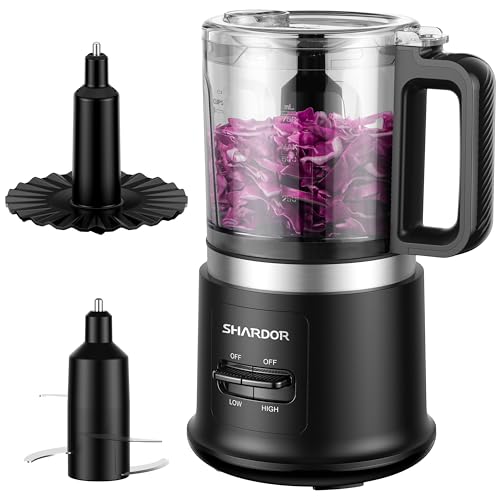
A whisk attachment alongside four bi-level blades and 400 claimed watts makes this the only pick that beats eggs as well as chopping onions.
Best for: cooks who want a whisk attachment alongside the chopping blades Skip it if: you need a published warranty term
The whisk is the story. Six other picks here chop, mince and puree. This one adds an attachment SHARDOR says will whip cream and beat eggs, which turns a single-purpose chopper into something you might reach for while baking. If your countertop is already crowded, one machine doing two jobs is a real space argument.
The rest of the specification reads well. SHARDOR claims 400 watts, second only to the Ganiza, with four bi-level stainless blades and a two-speed pulse system for texture control. The footprint is remarkable: 5.99 x 6 x 6 in, the smallest of any pick in this comparison. That is a machine you can leave out permanently. The listing also mentions overheating protection, an easy-grip handle, anti-slip stability and a spatula, and describes the materials as BPA-free food grade.
Then the gaps. No warranty term is published. No weight is published. Bowl capacity appears as 4 cups in the title, while the size field says only "M", which is not a measurement. And this is far and away the slowest seller of the seven, by an order of magnitude against the Hamilton Beach, while sitting in the premium end of the price order.
I'd want that warranty line before making this a daily-driver purchase. As an upgrade for someone who specifically wants the whisk, it earns its place.
Pros:
- Only pick with a whisk attachment
- 400 watts claimed, second highest here
- Smallest footprint at 5.99 x 6 x 6 in
- Two-speed pulse control plus stated overheating protection
- Spatula included
Cons:
- No warranty term published anywhere on the listing
- No weight published
- Slowest-selling pick of the seven by a wide margin
- Premium price position with fewer published specifications than rivals
7. TTFTTF Electric Garlic Chopper — Best for heavy use
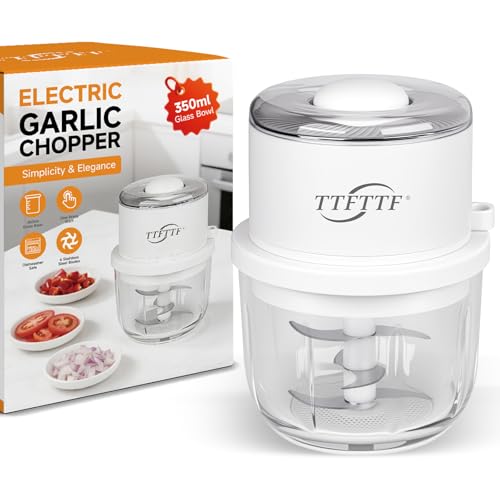
Cordless USB-C operation and a 350 ml glass bowl make this the pick for mincing away from an outlet, and nothing else here does that.
Best for: cordless mincing away from an outlet Skip it if: you chop more than a small handful at a time
One feature makes this worth listing: no cord. It charges over USB-C and runs on a battery, so it works on a picnic table, in an RV, or at the far end of a counter with no socket. Every other pick here needs an outlet. At 1.5 lb it is also the lightest of the seven by a clear margin.
The bowl is 350 ml of thick glass, which TTFTTF says is odour-resistant and won't absorb flavours. Six stainless blades and a 40 watt motor handle ingredients in 5 to 30 seconds by the brand's claim. Detachable bowl and blades are described as dishwasher safe, though the motor unit must not be washed.
Now the honest reckoning. 350 ml is roughly a cup and a half, less than half the Hamilton Beach bowl, so this is a garlic-and-ginger tool rather than an onion-and-carrot one. The 40 watt motor is a tenth of the SHARDOR's claimed figure, which is what a battery buys you. And the listing's warranty field contains charging instructions instead of a warranty term: use a 5V/1A or 5V/2A source, avoid fast chargers, charge 2 to 3 hours before first use.
The award label here reflects portability, not endurance. For daily bulk prep, this is the wrong shape of machine.
Pros:
- Only cordless pick in this comparison
- Lightest at 1.5 lb
- Glass bowl resists garlic and onion odours
- Second-cheapest of the seven
- Six blades with dishwasher-safe bowl and blade assembly
Cons:
- 350 ml bowl is by far the smallest here
- 40 watts is the lowest motor claim in the set
- No warranty term published; that field holds charging notes
- Requires specific 5V charging, no fast chargers
- Motor base cannot be washed
What the wattage number hides
Wattage is the number every listing shouts and the number that tells you least on its own. What matters is watts relative to bowl volume, because that ratio is what determines how hard the blade drives through a full load.
Run the numbers on this set:
- Hamilton Beach: 350W across 3 cups
- SHARDOR: 400W across 4 cups
- Ganiza: 450W across 8 cups
- La Reveuse: 300W across 7 cups
- Cuisinart DLC-2ABC: 250W across 3 cups
- Cuisinart ECH-4SV: wattage not published
- TTFTTF: 40W across 350 ml
The Hamilton Beach and SHARDOR sit at the top of that ratio. The Ganiza's headline 450 watts is the biggest figure here, but it is spreading that power across nearly three times the volume, and the listing's own overheating-protection note tells you the motor has limits when pushed.
Two speeds also do work that wattage cannot. Four of these picks offer two-speed pulse control: Ganiza, La Reveuse, SHARDOR and, in a different form, both Cuisinarts through their chop and grind buttons. The Hamilton Beach has one speed and relies on how long you hold the lid down.
So read wattage as a rough ceiling, not a promise. A single-speed 350 watt machine with a small bowl outperforms a 450 watt machine you have to run in a half-empty 8-cup bowl.
Glass or plastic bowl: which suits your routine?
Three picks here use glass and four use plastic, and the split matters more than most buyers expect.
Glass bowls appear on the Ganiza (one of its two), the La Reveuse and the TTFTTF. Glass does not absorb garlic and onion smell, does not stain from turmeric or tomato paste, and does not scratch into a cloudy haze after a year of blade contact. If you chop alliums most nights, that odour resistance alone is the argument. Both La Reveuse and TTFTTF call it out on their listings.
Plastic bowls appear on the Hamilton Beach, both Cuisinarts and the SHARDOR. Plastic is lighter, which is part of why the Hamilton Beach lands at 2.1 lb and the Ganiza at 5 lb. It survives being dropped. Every one of these listings states BPA-free construction, so the material safety question is settled on paper.
The Ganiza sidesteps the choice entirely by giving you both, plus a stainless steel bowl for raw meat.
My read: if garlic and onion are your daily job, glass earns the extra weight. If you want the lightest possible machine to lift in and out of a cupboard, plastic wins. Neither is wrong, and both are dishwasher safe across every listing here.
What owning one actually involves
The daily reality of a mini processor is not chopping. It is washing.
Every pick here states a dishwasher-safe bowl. That is not the whole picture. Blades are the part that needs attention, and only some listings say the blade comes out. Hamilton Beach specifically states removable blades that are dishwasher safe, and the Cuisinart ECH-4SV says all removable parts are dishwasher safe. TTFTTF says the detachable glass bowl and blades are safe but the motor cannot be washed, which is true of every electric pick here whether the listing says so or not.
Three habits keep any of these working:
- Rinse the bowl straight after use, before food dries onto the blade shaft.
- Never submerge the motor base. Wipe it, as the Cuisinart listing describes.
- Respect the overheating pause. Ganiza and SHARDOR both build in protection that stops the machine; waiting a few minutes is the fix, not repeated pressing.
Storage is the second half of the story. The SHARDOR at 5.99 x 6 x 6 in and the Hamilton Beach at 5.2 in tall are the two you can leave on a counter without resentment. The Ganiza at 5 lb with a spare bowl is a cupboard machine, and lifting 5 lb out nightly is a real friction that will quietly reduce how often you cook.
When a different pick wins
The best mini food processor for daily use changes with three specific conditions. Each is checkable before you buy.
If you grind raw meat, the Ganiza wins. It is the only pick with a dedicated stainless steel bowl separate from the glass one. Nothing else here lets you keep raw and cooked prep in different vessels without buying a second machine.
If your batches run past 3 cups, the La Reveuse wins. Its 7-cup glass bowl is more than double the Hamilton Beach. Batch cooking, baby food and party dips all want volume, and paying for a 3-cup bowl then filling it three times is a worse outcome than one 7-cup fill.
If you need to chop with no outlet nearby, the TTFTTF wins by default. It is the only cordless pick here. 350 ml is small and 40 watts is modest, but a machine that works is better than one you can't plug in.
If you whisk as often as you chop, the SHARDOR wins. No other pick includes a whisk attachment.
The threshold that decides between the Hamilton Beach and the bigger bowls is around 3 cups of finished volume per session. Below that line, small bowls chop more evenly and clean faster. Above it, you are pulsing in batches and the extra capacity pays for itself within a week.
The verdict
If you cook for one or two and chop onions, garlic and herbs most evenings, buy the Hamilton Beach 72850G. It is the cheapest pick here, carries 350 claimed watts against the 250 of the pricier Cuisinart DLC-2ABC, weighs 2.1 lb, and its press-the-lid control is the fastest interface in the group. One year of warranty is short but real, and it is the pick buyers in this category reach for most often.
If you cook for a family, prep in batches or make baby food, buy the La Reveuse LARB4016 instead. Its 7-cup glass bowl is more than double the Hamilton Beach, glass keeps onion smell out of your dips, and two-speed pulse control gives you the texture range a single-speed machine cannot. You give up a published weight figure and you accept the tallest body here at 8.72 in.
The cutoff is 3 cups of finished food per session. Below it, the smaller bowl chops more evenly and washes faster. Above it, the bigger bowl saves you from pulsing in shifts.
The Ganiza GC10 has one advantage neither of them can match: a separate 8-cup stainless steel bowl for raw meat. If you grind your own burger meat, that hygiene separation outweighs its 5 lb bulk and its missing warranty line.
FAQ
Is a mini food processor worth it for daily use?
A mini food processor is worth it for daily use if you chop alliums, herbs or nuts several times a week. The saving is time and eye irritation, not skill. Under 3 cups per session, a small machine like the 2.1 lb Hamilton Beach outperforms a full-size processor because a smaller bowl keeps ingredients in the blade path.
Which mini food processor gives the most for the money?
The most for the money here is the Hamilton Beach 72850G. It sits at the bottom of the price order, publishes 350 watts against the 250 of a much pricier Cuisinart, states a one year warranty, and weighs 2.1 lb. The Cuisinart ECH-4SV sits at the top of the price order without publishing a wattage figure at all.
Can a mini food processor grind meat?
A mini food processor can grind meat, and the Ganiza GC10 is built around it with a dedicated 8-cup stainless steel bowl kept separate from its glass one, plus 450 claimed watts and two speeds. Keeping raw meat in its own bowl is the point. The SHARDOR listing also mentions shredding chicken with its four bi-level blades.
Hamilton Beach or Cuisinart Mini-Prep: which should I pick?
Hamilton Beach or Cuisinart Mini-Prep comes down to control style and power. Both hold 3 cups and weigh about 2.1 to 2.2 lb. Hamilton Beach claims 350 watts and you press the lid; Cuisinart claims 250 watts with labelled chop and grind buttons and an 18-month warranty. Pick Cuisinart for the longer warranty, Hamilton Beach for more claimed power at a lower price.
What mistake do mini food processor buyers make most often?
The mistake buyers make most often is buying too much bowl. An 8-cup bowl needs roughly a third filling to chop evenly, so two garlic cloves just spin around the edges. Buy a bowl slightly larger than your usual batch. If that batch is under 3 cups, a 3-cup or 4-cup machine chops better and washes faster.
Start with the specification that matches your actual weeknight: bowl capacity first, wattage second, warranty third. For most people cooking small, the Hamilton Beach 72850G is the sensible default, and its 5.2 in height is the quiet reason it keeps getting used rather than shelved. A machine you can pull out one-handed and rinse in thirty seconds gets used four nights a week. A 5 lb machine with a spare bowl gets used on Sundays. Decide which of those you'll genuinely be, then buy for that person rather than the ambitious one.