Best Premium Roti Maker When Counter Space Is Tight

Six roti makers, from an 8 lb cast iron press to a 46.3 lb automatic cabinet. Which one fits your kitchen, and which spec actually decides the purchase.

By Quinn BellUpdated 16 min read
On this page
- Best premium roti maker at a glance
- How I cut this best premium roti maker field down to six
- Does a premium roti maker actually fit your counter?
- 1. Apecoo Fully Roti Maker, Automatic Chapati Maker — Best overall
- 2. HMKDQBD Roti Maker — Best upgrade
- 3. ToolHaven Fully Automatic Roti Maker with Touchscreen — Best minimal setup
- 4. Generic Fully Automatic Roti Maker & Electric Chapati — Best premium
- 5. EABOSON 10inch Roti Maker Machine — Best for pros
- 6. Victoria 8 Inches Cast Iron Tortilla Press — Best budget pick
- Fully automatic or press: which best premium roti maker suits you?
- What the listings don't tell you
- Apecoo vs ToolHaven: which automatic wins?
- The verdict
- FAQ
The best premium roti maker is the Apecoo Fully Roti Maker, because it's the only fully automatic machine here that publishes both its footprint (16 x 15 x 16 in) and its weight (36.2 lb) before you commit counter space to it. If you'd rather press dough and cook it yourself, the EABOSON 10inch handles 10 in flatbreads with a temperature knob and a removable handle. The specification that splits this field isn't thickness range or batch size. It's depth. These automatic machines are cabinets, not gadgets, and one of them is 21.3 in deep.
Best premium roti maker at a glance
| Pick | Type | Footprint | Price |
|---|---|---|---|
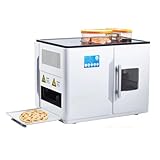
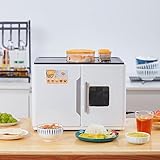
Best overall Apecoo Fully Roti Maker, Automatic Chapati Maker |
Fully automatic | 16 x 15 x 16 in, 36.2 lb | Check Price |
Best upgrade HMKDQBD Roti Maker |
Fully automatic | Not published | Check Price |
Best minimal setup ToolHaven Fully Automatic Roti Maker with Touchscreen |
Fully automatic | 18.1 x 21.3 x 16.1 in, 46.3 lb | Check Price |
| Fully automatic | Not published | Check Price | |
Best for pros EABOSON 10inch Roti Maker Machine |
Electric press | 10 in plate | Check Price |
Best budget pick Victoria 8 Inches Cast Iron Tortilla Press |
Manual press | 3.1 x 8 x 8 in, 8 lb | Check Price |




How I cut this best premium roti maker field down to six
Three things got listings cut before I compared anything else.
First, listings with no published dimensions and no published weight and no stated power figure. A machine that automates dough handling is a substantial box, and a listing that won't say how big the box is has told you something. Two picks here still publish neither measurement, and I've flagged that in their sections rather than pretending it away.
Second, anything sold as a roti maker that's really a griddle. A flat pan with a lid isn't doing the pressing or the kneading, and it changes what you're buying.
Third, single-function novelty machines with one temperature. Roti and crepe want different heat. Every pick here either has multiple settings, a variable knob, or no heating element at all.
What survived splits three ways:
- Three fully automatic cabinets that measure flour, dispense water, knead and cook, according to their listings.
- One electric press with a temperature knob and a 10 in plate.
- One manual cast iron press, 8 lb, with a limited lifetime warranty.
That range is deliberate. The word "premium" in this category gets attached to two completely different ideas, and one of them costs a fraction of the other.
Does a premium roti maker actually fit your counter?
Measure before you read another spec. Standard base cabinets run about 24 in deep, and the usable strip in front of a backsplash is often nearer 22 in once you allow for an outlet and a splash gap.
The ToolHaven is 21.3 in deep. That's not a small appliance. That's a countertop microwave with a taller lid, and it weighs 46.3 lb, which means it goes in one spot and stays there. The Apecoo is 15 in deep and 16 in wide, which is a genuinely different proposition: it leaves working room beside it.
Height matters too. Both automatics sit at roughly 16 in tall, so neither slides under a wall cabinet with 18 in of clearance and any room to open a lid. Plan for open counter, not an appliance garage.
The presses barely register. The Victoria is 3.1 x 8 x 8 in and stores in a drawer. The EABOSON has a removable handle specifically so it takes less room on a shelf.
Three questions worth answering with a tape measure:
- How deep is the usable counter, from backsplash to edge?
- Is there an outlet within reach that isn't shared with a kettle?
- Can you lift 46.3 lb onto that counter without help?
1. Apecoo Fully Roti Maker, Automatic Chapati Maker — Best overall
The only fully automatic pick that publishes its footprint and weight, and the numbers are the friendliest of the three.
Best for: a family that wants automatic rotis without surrendering a whole counter run Skip it if: your usable counter depth is under 15 in
What separates this from the other automatics is information. At 16 x 15 x 16 in and 36.2 lb, you can decide today whether it fits, and it's 6.3 in shallower and 10.1 lb lighter than the ToolHaven. In a category where nobody publishes power draw, dimensions become the specification you can actually act on.
Apecoo says the machine measures flour, dispenses water, mixes and kneads without manual handling, and that a touch panel adjusts dough moisture, browning and oil dosage. Three baking settings are listed as L1, L2 and L3, with L1 aimed at soft breakfast pancakes and L3 at crisp-outside rotis. The listing also claims a brushless motor for quieter running and dishwasher-safe removable parts, which is the more interesting claim of the two: cleaning is where automatics get abandoned.
The finish is golden, which is a commitment in a stainless kitchen. It's also the slowest seller of the four automatics here and only one seller lists it, so choice is limited. Against the ToolHaven you give up published stainless construction; against the presses you give up the ability to store it out of sight.
Pros:
- Smallest published footprint of the automatics, 16 x 15 x 16 in
- 36.2 lb, lightest of the two measured automatics
- Three baking levels, L1 through L3
- Removable parts claimed dishwasher-safe
- Touch control for moisture, browning and oil
Cons:
- Golden finish clashes with stainless kitchens
- Slowest seller among the automatic picks here
- Only one seller lists it
- No published power rating or warranty
2. HMKDQBD Roti Maker — Best upgrade
The automatic that buyers here pick most often, with a stated 20-piece batch and a 1.0 mm thickness floor.

Best for: batch cooking 20 flatbreads for a crowd Skip it if: you need published weight and dimensions before you buy
This is the one buyers choose most often across the six, and it's the mid-priced automatic rather than the dearest, which is an unusual combination. The listing claims 20 pieces in one run, a large touch panel for thickness, roasting time and oil level, and a thickness range starting at 1.0 mm. For anyone cooking for six or more people, batch size is the number that changes dinner.
HMKDQBD describes a three-layer design for even cooking and puffing, and a door interlock that stops the machine when the front is opened. That safety detail matters more than it sounds in a machine handling hot plates at counter height with children nearby.
The gap is measurement. No published weight, no published dimensions, no stated warranty, and the model designation is simply A-1. You're buying a large automatic appliance without knowing how large. Only one seller lists it, so there's no second listing to cross-check. Against the Apecoo you gain batch capacity and lose the ability to plan your counter. Against the EABOSON press you gain full automation and lose any way to store it away.
Pros:
- Claimed 20-piece batch, largest stated capacity here
- Thickness adjustable from 1.0 mm upward
- Door-open auto-stop described in the listing
- The automatic buyers here choose most often
- Mid-range price position for a full automatic
Cons:
- No published dimensions or weight at all
- No stated warranty
- Only one seller lists it
- Generic A-1 model designation gives you nothing to research
3. ToolHaven Fully Automatic Roti Maker with Touchscreen — Best minimal setup
Stainless body, a claimed 120-second cycle, and the biggest footprint of anything here at 18.1 x 21.3 x 16.1 in.
Best for: a stainless kitchen with deep counters and a dedicated appliance spot Skip it if: you plan to move it, ever
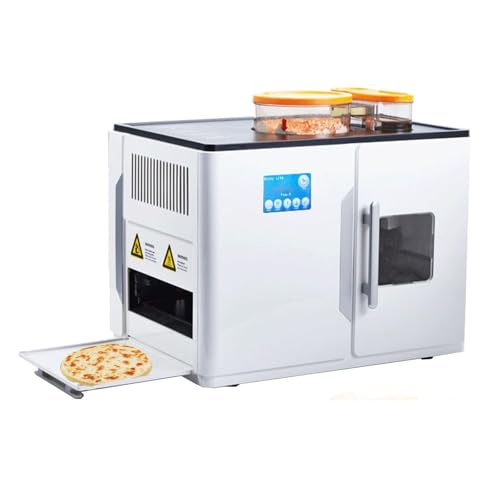
ToolHaven publishes what the other automatics won't, and the numbers are honest about what this thing is: 18.1 x 21.3 x 16.1 in, 46.3 lb, stainless steel main body. Once it's placed, it's furniture. The upside of that mass is a machine you set up once and stop thinking about, hence the minimal-setup label. The downside is that 21.3 in of depth eats most of a standard counter.
The listing claims a full cycle from dry flour to a puffed flatbread in about 120 seconds, thickness control from 1.0 mm on a touch panel, one-click production, and a door-open pause. It also lists roti, chapati, tortilla, pancake, pita and dosa as intended uses, which is the broadest stated range among the automatics.
Two honest marks against it. It's the heaviest pick by 10.1 lb, and it's the deepest by 6.3 in. It's also priced below the Apecoo while offering published stainless construction, which makes the Apecoo's advantage purely spatial. If your counter can take it, that's a fair trade. If it can't, no amount of stainless helps.
Pros:
- Stainless steel main body, stated in the listing
- Full dimensions and 46.3 lb weight published
- Claimed 120-second flour-to-flatbread cycle
- Six named flatbread types including dosa and pita
- Mid-range price for a measured automatic
Cons:
- Deepest pick here at 21.3 in
- Heaviest at 46.3 lb, effectively a permanent installation
- No published warranty or power rating
- Only one seller lists it
4. Generic Fully Automatic Roti Maker & Electric Chapati — Best premium
The most expensive pick in the set, and the one that publishes the least about itself.
Best for: someone buying on look and finish for a white kitchen Skip it if: you want measurements published before you commit
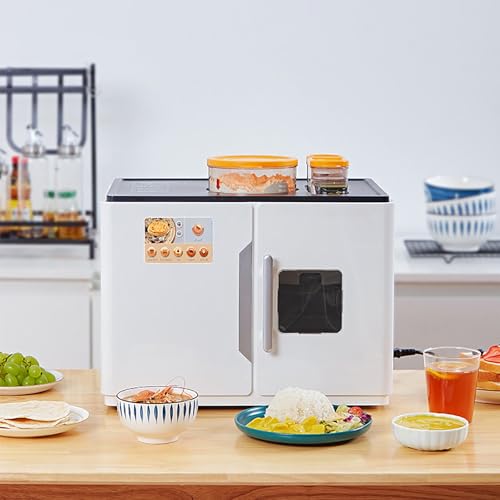
This sits at the top of the price ladder here, and the case for it is presentation rather than data. The listing describes a sturdy stainless steel body under a white finish, an intuitive touch panel for thickness, roasting time and oil level, and what it calls a unique cactus design intended for home kitchens, small restaurants and canteens. If you want an automatic that reads as a designed object rather than a machine, that's the pitch.
What you don't get is numbers. Colour and count are the only published specs. No weight, no dimensions, no thickness range in millimetres, no stated batch size, no warranty, and the model is listed as Generic. That's a hard position to defend when the ToolHaven publishes 18.1 x 21.3 x 16.1 in and 46.3 lb at a lower price position.
I'd only choose this over the Apecoo if the white finish genuinely matters to your kitchen and you're prepared to measure the delivered unit yourself. Against every other automatic here, it asks for more and tells you less. Only one seller lists it.
Pros:
- Stainless steel body described beneath a white finish
- Touch panel for thickness, roasting time and oil level
- One-touch operation stated in the listing
- White colourway suits light kitchens
Cons:
- Highest price position here with no extra published capability
- No dimensions, weight, warranty or power figure published
- Model listed only as Generic, nothing to research
- Only one seller lists it
5. EABOSON 10inch Roti Maker Machine — Best for pros
A 1200W electric press with a variable temperature knob and the largest cooking surface of any press here at 10 in.

Best for: cooks who make their own dough and want 10 in flatbreads fast Skip it if: you want the machine to knead for you
This is the pick for someone who already makes dough well and just wants the pressing and cooking done in one motion. It runs on AC 110V 50/60Hz at 1200W and presses a 10 in round, which is 2 in wider than the Victoria's plate. For parathas or large tortillas, that difference is the whole point.
EABOSON lists a customisable temperature knob rather than fixed settings, which is the more flexible arrangement: soft rotis and crisp golden flatbreads want different heat, and a knob covers the range between. The housing is described as stainless steel with a non-stick cooking coating, and the handle detaches for storage.
It's the second-cheapest pick here, which makes it the value play for anyone unconvinced by the automatics. The trade-off is labour. You mix, you rest, you divide, you portion. It also carries no published warranty and no listed dimensions beyond the 10 in plate size, so shelf planning takes guesswork. Against the automatics you lose kneading entirely; against the Victoria you gain heat and lose a lifetime warranty.
Pros:
- 1200W with variable temperature knob
- 10 in plate, largest press surface here
- Non-stick coating over stainless housing
- Removable handle for compact storage
- Second-cheapest pick in the set
Cons:
- You still mix and portion the dough yourself
- No published warranty
- No published weight or overall dimensions
- Non-stick coatings wear with metal utensils
6. Victoria 8 Inches Cast Iron Tortilla Press — Best budget pick
The only pick here with a published warranty, and it's a limited lifetime one.

Best for: anyone who wants a tool that lasts decades and never breaks Skip it if: you want cooking and pressing in one step
Six picks, one warranty. Victoria publishes a limited lifetime warranty on this cast iron press, and none of the five electric machines states any warranty at all. That single line reframes the whole "premium" question, because a tool with no motor, no board and no coating has nothing to fail.
At 3.1 x 8 x 8 in and 8 lb, it's the smallest and lightest pick by a wide margin, and the only one that lives in a drawer. Victoria says it's seasoned with non-GMO, kosher-certified flaxseed oil and made without PTFE or PFAS, with engineered flat plates designed to prevent pinching. The company states it has made cast iron in its own Colombian factories since 1939. It's also the fastest seller of the six by a considerable distance.
The limits are real. It presses only, so you need a skillet or comal and a burner. The plate is 8 in, 2 in smaller than the EABOSON. And bare cast iron needs care: the listing specifically says never air-dry it and never put it in a dishwasher, which is the opposite of the Apecoo's dishwasher-safe parts.
Pros:
- Limited lifetime warranty, the only one here
- 8 lb and 3.1 x 8 x 8 in, stores in a drawer
- No PTFE or PFAS, seasoned with flaxseed oil
- Cheapest pick of the six
- Sells faster than the rest of this set
Cons:
- Presses only, needs a separate skillet and burner
- 8 in plate, smallest cooking round here
- Hand-dry required, never dishwasher safe
- No temperature control of any kind
Fully automatic or press: which best premium roti maker suits you?
The automatics and the presses aren't competing products. They solve different halves of the job.
An automatic handles the part most people find tedious: measuring flour, hydrating it, kneading, resting, portioning. All three automatics here claim to do that from dry flour, and two claim a 20-piece run. If dough-making is what stops you cooking rotis on a Tuesday, that's the fix.
A press handles the part most people find fiddly: getting an even, thin round without a rolling pin and a floured board. The Victoria and the EABOSON both do that, and the EABOSON cooks as well. But you supply the dough.
Rough decision rules:
- Cooking flatbreads more than three times a week for four-plus people, and dough is your bottleneck? Automatic.
- Already comfortable with dough, want speed and even rounds? EABOSON press.
- Cooking occasionally, want zero maintenance and a tool that outlives the kitchen? Victoria.
- Counter depth under 15 in? Press, no exceptions.
The mistake is buying an automatic for occasional use. A 36.2 lb to 46.3 lb machine used twice a month is a very expensive counter ornament, and you can't put it away.
What the listings don't tell you
Four gaps run right across this category, and knowing them makes you a better judge of any listing you find.
Power draw. Only the EABOSON publishes a figure, at 1200W. None of the three automatics states one. That matters if the counter circuit already runs a kettle and a toaster.
Noise. Apecoo claims a brushless motor for "ultra-quiet running", which is the only noise claim in the set and it's a claim, not a measurement. No decibel figure appears anywhere.
Consumable parts. Automatics have hoppers, water lines and non-stick plates. Nobody here says whether those are replaceable or what a replacement involves. Apecoo at least states removable parts are dishwasher-safe.
Flour behaviour. Every automatic listing describes "dry flour" going in. None specifies which flours work. Atta, all-purpose and masa hydrate very differently, and a machine tuned for one may struggle with another. Plan on some trial and error whichever automatic you choose.
That last point is the honest caveat on the word "premium" in this category. The listings describe capability; none of them documents limits.
Apecoo vs ToolHaven: which automatic wins?
These two are the only automatics that publish measurements, so this is the only head-to-head you can settle on data.
The ToolHaven gives you a stated stainless steel body, a claimed 120-second cycle, six named flatbread types, and a lower price position. The Apecoo gives you three named baking levels, dishwasher-safe removable parts, and a footprint 6.3 in shallower and 10.1 lb lighter.
On paper, ToolHaven looks like the better buy. In practice, 21.3 in of depth and 46.3 lb rules it out of a lot of kitchens, and no feature list rescues an appliance that doesn't fit. The Apecoo at 15 in deep clears a standard counter with room to work beside it.
So the cutoff is your counter. Under 22 in of usable depth, take the Apecoo. Over that, and if you're happy leaving it permanently in place, the ToolHaven is the stronger machine for less money. The golden finish versus stainless is a genuine tiebreaker if you're undecided.
The verdict
If you have less than 22 in of usable counter depth, the Apecoo Fully Roti Maker is the pick. It's the only automatic in this set that publishes both a footprint (16 x 15 x 16 in) and a weight (36.2 lb) small enough to place confidently, and the three L1 to L3 baking levels plus dishwasher-safe removable parts address the two things that make automatics get shelved: inflexible heat and awkward cleaning.
If you have deeper counters and a permanent spot, the ToolHaven Fully Automatic wins instead. Stainless body, a claimed 120-second cycle, six named flatbread types, and a lower price position than the Apecoo. The cutoff is 22 in of counter depth, measured from backsplash to edge, because at 21.3 in deep and 46.3 lb the ToolHaven goes down once and never moves.
Outside those two, the HMKDQBD is the automatic buyers here reach for most, with a stated 20-piece batch, if you'll accept a listing with no published measurements. The EABOSON is the sensible choice for anyone who already makes dough and wants a 1200W press with a 10 in plate. And the Victoria remains the only pick in the set with a published warranty.
FAQ
Is a premium roti maker worth the money?
A premium roti maker is worth the money if dough preparation is the specific thing keeping you from cooking flatbreads regularly. The automatics here claim to measure, hydrate, knead and cook from dry flour, and two state 20-piece batches. Cooking twice a month, though, a 36.2 lb machine you can't store is poor value against an 8 lb press.
What's the cheapest way to make good rotis at home?
The cheapest way here is the Victoria 8 Inches Cast Iron Tortilla Press, the lowest-priced pick of the six. At 3.1 x 8 x 8 in and 8 lb it presses even 8 in rounds and carries a limited lifetime warranty, the only warranty in this set. You supply the dough, the skillet and the burner heat.
How much counter space does a fully automatic roti maker need?
Counter space needs vary sharply between the automatics. The Apecoo is 16 x 15 x 16 in and 36.2 lb. The ToolHaven is 18.1 x 21.3 x 16.1 in and 46.3 lb, deeper than many countertop microwaves. Both stand about 16 in tall, so neither fits under a wall cabinet with the lid opening. Measure your usable depth first.
Apecoo or EABOSON: which should I choose?
Choose between Apecoo and EABOSON on whether you want to make dough. The Apecoo automates the whole process with three baking levels and dishwasher-safe removable parts. The EABOSON is a 1200W press with a variable temperature knob and a 10 in plate, second-cheapest here, but you mix and portion yourself. Dough skills decide it.
What mistake do first-time roti maker buyers make?
The mistake first-time buyers make is choosing on batch size instead of footprint. A stated 20-piece run sounds decisive until a 21.3 in deep, 46.3 lb machine arrives and there's nowhere to put it. Also worth noting: no automatic listing here specifies which flours it handles, so budget time for trial runs with atta or masa.
Take a tape measure to the counter before you open another listing. That single number, usable depth from backsplash to edge, eliminates half this field for most kitchens and turns a confusing category into a two-way choice. Under 22 in, the Apecoo is your automatic. Over it, the ToolHaven does more for less. And if the answer is that no 36 lb appliance is ever living on your counter, the Victoria press has been solving this problem since 1939 without a single component that can fail.