Best Premium Pressure Cookers for 12-Quart Batches
Seven pressure cookers compared on published capacity, weight and stovetop compatibility, from a 6.3-quart starter pot to a 53-quart commercial vessel. The winner is the one that actually holds a family-sized batch.
The best premium pressure cooker for large families is the Peterboo Premium 12 Quart Stainless Steel Pressure Cooker, because 12.7 quarts of published capacity is nearly double what the next-largest home-scale pick here offers. If you'd rather set a program and walk away, the Instant Pot Duo 6 Qt handles that at 6 quarts with 13 one-touch options. Capacity is what splits this field, and it splits it hard: the seven picks below run from 6.3 quarts to 53 quarts. That range is not a spectrum of "family sizes". It is a line between home cooking and commercial catering, and crossing it by accident is the expensive mistake here. Everything else follows from where you land on it.
Best premium pressure cooker for large families at a glance
| Pick | Capacity | Weight | Price |
|---|---|---|---|
| Best overall Peterboo Premium 12 Quart Stainless Steel Pressure Cooker |
12.7 quarts | 13 lb | Check Price |
| Runner-up Instant Pot Duo 6 Qt 7-in-1 Electric Pressure Cooker |
6 quarts | 14.6 lb | Check Price |
| Best premium Fissler Vitavit Premium Pressure Cooker with Steamer |
8.5 quarts | 10.1 lb | Check Price |
| Best for heavy use Fissler Vitaquick Premium Pressure Cooker |
8.5 quarts | 12.6 lb | Check Price |
| Best for beginners T-fal Clipso Stainless Steel Pressure Cooker |
6.3 quarts | 7.7 lb | Check Price |
| Best budget pick KOCH SYSTEME CS Stainless Steel Pressure Cooker 6.3 Quart |
6.3 quarts | Not published | Check Price |
| Best for families Universal (Extra Large) 53-Quart Aluminum Pressure Cooker |
53 quarts | 26.6 lb | Check Price |
How I screened these seven pressure cookers
I lined up the published specifications for every pot side by side and compared only what the listings actually state. Capacity, weight, dimensions, model number, stated warranty, stovetop compatibility. No estimates.
Three things shaped the ranking:
- Published capacity, weighted highest. A pressure cooker that can't hold the batch is the wrong pot regardless of how well it's made. Six of the seven sit between 6 and 12.7 quarts. One sits at 53.
- Completeness of the listing. Four picks publish dimensions or a warranty. Three publish neither. That gap matters when you're buying something that has to fit a burner and a cabinet.
- Stovetop compatibility, where stated. Two picks explicitly claim induction support. One explicitly states it does not work on induction. The rest say nothing, which is its own answer.
What got cut, and why:
- Anything where the listed capacity was the only published figure. You need at least a weight or a footprint to plan around.
- Pots whose feature bullets read as pure marketing with no comparable number attached.
One note on the phrase in the search box. Amazon's results for best premium pressure cooker for large families do not actually filter for family-scale capacity, which is why a 6-quart electric pot and a 53-quart commercial vessel show up in the same set. You have to apply that filter yourself. I've made capacity the first column of the table for exactly that reason.
1. Peterboo Premium 12 Quart Stainless Steel Pressure Cooker — Best overall
At 12.7 quarts, this is the only pick that comfortably holds a family-scale batch without stepping into commercial-kitchen territory.

Best for: cooking one big batch of stew or beans in a single pot Skip it if: you have an induction cooktop and need confirmed compatibility
Capacity is the whole argument. At 12.7 quarts, the Peterboo holds more than double the Instant Pot Duo's 6 quarts and roughly half again what either Fissler offers at 8.5 quarts. If your problem is that a 6-quart pot forces you into two batches of chili on a Sunday, this is the pot that solves it. Nothing else here in the home-scale range comes close.
It weighs 13 lb, which puts it heavier than the 10.1 lb Fissler Vitavit and lighter than the 26.6 lb Universal. That's a sensible middle: substantial enough to feel like real cookware, still liftable when full is not something you'd attempt with 53 quarts of soup. Peterboo lists the model as 12.68QT and describes food-grade heavy-duty stainless steel with an encapsulated base, plus a multi-stage safety setup covering a locking lid, pressure indicator, anti-blocking vent and overheat protection. Those are the manufacturer's claims, not measured figures.
The trade-off against the Fisslers is documentation. The listing publishes no dimensions and no warranty, and only one seller stocks it. You're buying the biggest usable pot in the set and accepting a thinner paper trail.
Pros:
- 12.7 quarts, the largest home-scale capacity here
- 13 lb sits mid-range for weight in this set
- Encapsulated base claimed for even heat
- Multi-stage safety system per the listing
- Cheapest of the three largest pots
Cons:
- No published dimensions, so cabinet fit is guesswork
- No stated warranty, unlike the T-fal or Instant Pot
- Only one seller lists it
- No stated induction compatibility
2. Instant Pot Duo 6 Qt 7-in-1 Electric Pressure Cooker — Runner-up
The only electric pick here, and the only one that cooks unattended on a timer.

Best for: hands-off weeknight cooking with a timer and a warm setting Skip it if: you regularly cook for more than five or six people
The Duo trades capacity for convenience, and for a lot of households that's the right trade. It holds 6 quarts, the smallest figure in this comparison, but it's the one pot you can load, program and leave. Instant Pot lists 7 cooking functions covering pressure, slow cook, sauté, steam, rice, yogurt and keep-warm, plus 13 one-touch programs. No other pick here does anything after you walk away from the stove.
It's also the pot buyers here choose most often by a wide margin, which tells you something about how many people actually want programmability over volume.
The specifications are the most complete in the set. Dimensions are published at 12.2 x 13 x 12.6 in, weight at 14.6 lb, and there's a 1-year manufacturer warranty stated. Instant Pot describes an 18/8 stainless inner pot with a tri-ply bottom and an easy-release steam switch. Note the footprint: at nearly 13 inches tall it needs vertical clearance, and it's a countertop resident, not something you stash in a low cabinet.
Against the Peterboo, the loss is stark. Six quarts against 12.7 means you're doing two runs where the Peterboo does one, and the Duo's 14.6 lb is the heaviest of anything under 13 quarts here.
Pros:
- Only pick with a timer and keep-warm function
- 13 one-touch programs claimed
- 1-year warranty published
- Full dimensions listed at 12.2 x 13 x 12.6 in
- The pot buyers here choose most often
Cons:
- 6 quarts, the smallest capacity in the set
- Heaviest pot under 13 quarts at 14.6 lb
- Permanent counter footprint, 12.6 in tall
- Electric only, so no stovetop searing over high flame
3. Fissler Vitavit Premium Pressure Cooker with Steamer — Best premium
The most expensive pick here, and the only one that publishes dimensions, four pressure settings and confirmed induction support.

Best for: someone who wants German engineering and induction compatibility Skip it if: 12 quarts of headroom matters more than build refinement
At 8.5 quarts, the Vitavit lands between the Instant Pot's 6 and the Peterboo's 12.7, which is enough for a family roast and stock in one go. What separates it is the level of detail on the listing. Dimensions of 8.7 x 18.5 x 11.6 in, a weight of 10.1 lb, and a model number of 622-812-08-070/0. It also weighs less than every other pot here except the T-fal, which matters more than people expect when you're lifting 8.5 quarts of liquid.
Fissler describes 4 adjustable settings, more granular control than any other stovetop pick in this comparison, and a cookstar all-stove base rated for gas, electric, ceramic and induction. That last point is the one to note: it's the only pick that explicitly names induction and includes a steamer insert and metal lid. Fissler also claims a 70% cooking-time reduction and up to 90% vitamin retention, which is their figure rather than a tested one.
The honest weakness is capacity per dollar. It's the priciest pot in the set and holds 4.2 quarts less than the Peterboo, which costs less. You're paying for build and documentation, not volume.
Pros:
- Lightest of the 8.5-quart-plus pots at 10.1 lb
- 4 adjustable pressure settings claimed
- Induction compatibility explicitly stated
- Steamer insert and metal lid included
- Full dimensions published
Cons:
- Most expensive pick here for 8.5 quarts
- 4.2 quarts less capacity than the cheaper Peterboo
- No stated warranty on the listing
- Only one seller stocks it
- Slowest seller of the seven
4. Fissler Vitaquick Premium Pressure Cooker — Best for heavy use
Same 8.5-quart capacity as the Vitavit but 2.5 lb heavier, which usually means more metal in the base.

Best for: daily cooking where a heavier, thicker pot pays off Skip it if: you want published dimensions and a full feature list before buying
The Vitaquick and the Vitavit are the only two pots in this comparison that share a capacity figure, so the comparison is unusually clean. Both hold 8.5 quarts. The Vitaquick weighs 12.6 lb against the Vitavit's 10.1 lb, a 2.5 lb difference in the same volume. Extra mass in a pressure cooker generally sits in the base and the walls, and heavier walls hold temperature steadier through a long braise. It's also the cheaper of the two Fisslers.
The listing includes a steamer insert and tripod, and Fissler states it's precision-engineered in Germany with a claimed 70% faster cooking time and up to 90% nutrient retention. Model number 602-810-08-0700.
Here's where it gets thin. This is the sparsest listing of the seven: one feature bullet, no dimensions, no warranty, no stated stovetop compatibility. Compare that with its own sibling, which publishes a footprint, four pressure settings and induction support. You're buying on brand and weight rather than documented capability, and only one seller lists it.
Against the Peterboo, the Vitaquick costs more and holds 4.2 quarts less. Choose it if build quality outweighs volume.
Pros:
- 12.6 lb suggests a thicker, heat-stable base
- Steamer insert and tripod included
- Cheaper than the Vitavit at identical 8.5-quart capacity
- German manufacture stated on the listing
Cons:
- Sparsest listing here, with one feature bullet
- No published dimensions or warranty
- Stovetop and induction compatibility not stated
- 4.2 quarts less capacity than a cheaper pick
- Only one seller lists it
5. T-fal Clipso Stainless Steel Pressure Cooker — Best for beginners
The lightest pot here at 7.7 lb, with a one-handed lid and the longest stated warranty in the set.

Best for: a first stovetop pressure cooker with a one-handed lid Skip it if: you need more than 6.3 quarts of capacity
If pressure cooking makes you nervous, weight and lid mechanics matter more than volume. At 7.7 lb the Clipso is the lightest pot in this comparison by 2.4 lb, and T-fal describes a lid that opens and closes with one hand plus a five-point safety system. That's the friendliest combination here for someone who hasn't done this before.
The warranty is the standout. T-fal states a 10-year warranty on the pot, which is the longest coverage published by any pick in this set and ten times the Instant Pot's stated 1 year. Dimensions are listed at 8.89 x 14.5 x 11.4 in, so you can check the burner and cabinet before buying. The listing also mentions a recipe book, a steam basket, an adjustable pressure valve and a dishwasher-safe stainless pot.
Capacity is 6.3 quarts, marginally above the Instant Pot but half the Peterboo. T-fal's own bullet calls that enough for large batches, which is generous phrasing for a pot this size. For a family of five, it's one meal, not leftovers.
Against the Peterboo, the loss is 6.4 quarts. Against the Fisslers, you give up build weight and adjustable pressure levels.
Pros:
- Lightest pick here at 7.7 lb
- 10-year warranty on the pot, the longest stated
- One-handed lid operation claimed
- Recipe book and steam basket included
- Full dimensions published
Cons:
- 6.3 quarts is half the Peterboo's capacity
- No adjustable pressure levels stated, unlike the Vitavit's four
- Lightest build may mean thinner base for long braises
- Induction listed on the title but no all-stove base detail
6. KOCH SYSTEME CS Stainless Steel Pressure Cooker 6.3 Quart — Best budget pick
The cheapest of the seven, and the only inexpensive pot here that publishes three specific pressure settings.

Best for: spending the least while still getting three pressure settings Skip it if: you want a published weight and warranty before ordering
Cheap pressure cookers usually strip out control. This one doesn't, at least not on paper. KOCH SYSTEME lists three pressure settings at 100, 60 and 0 kPa, actual numbers rather than vague "high and low" labels, and only the Fissler Vitavit's four settings beats that. For the cheapest pot in the comparison, that's more adjustability than you'd expect.
Capacity is 6.3 quarts, matching the T-fal exactly. The listing describes an 18/10 stainless interior, a one-hand rotary knob for locking, stated induction compatibility, and a 3-in-1 setup that includes a glass lid and steamer alongside the pressure lid. The glass lid is a genuinely useful inclusion: it turns the pot into a regular stockpot between pressure jobs, which no other pick here offers.
The documentation is the weakest of the seven. No published weight, no dimensions, and the model field just reads "pressure cooker". You can't plan a burner fit or a cabinet shelf from that, and there's no stated warranty to fall back on.
Against the Peterboo, you lose 6.4 quarts of capacity. Against the T-fal at a similar size, you lose the 10-year pot warranty and every published measurement.
Pros:
- Cheapest pick in this comparison
- Three pressure settings at 100/60/0 kPa
- Glass lid and steamer included alongside pressure lid
- 18/10 stainless interior claimed
- Induction compatibility stated
Cons:
- No published weight or dimensions
- Model number is not a usable identifier
- No stated warranty
- 6.3 quarts, tied for smallest stovetop capacity here
7. Universal (Extra Large) 53-Quart Aluminum Pressure Cooker — Best for families
53 quarts of commercial capacity, and the listing itself says it's not for a standard home kitchen.
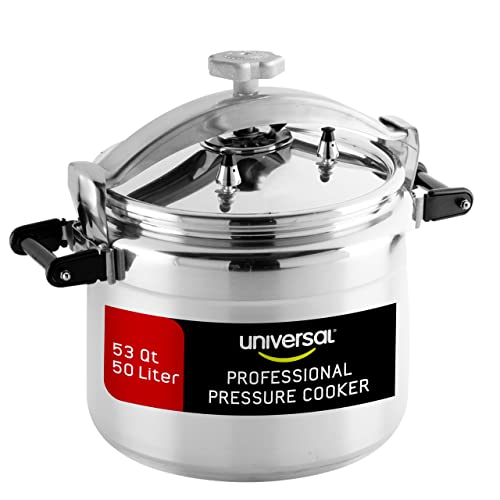
Best for: catering, canning volume or a commercial kitchen Skip it if: you cook on induction or in a standard home kitchen
This is the outlier, and I've placed it last deliberately. At 53 quarts it holds more than four times the Peterboo's 12.7 quarts, and Universal's own first feature bullet states plainly that it's too large and too powerful for typical home kitchens. Believe them. That's an unusually honest listing and the single most useful sentence on it.
Where it makes sense is real volume work: batch soups and meats for a restaurant, a church kitchen, a catering run. The listing describes 2 safety valves plus 2 pressure regulator valves, reinforced burn-resistant handles and an easy-open aluminum lid. It's compatible with gas, electric and glass-ceramic cooktops, and the listing explicitly states it is not induction compatible. That's the only pick here that rules a cooktop type out.
At 26.6 lb empty it's the heaviest pot in this set by 12 lb, and filled it's a two-person lift. It's also aluminum rather than stainless, which is lighter per quart but reacts with acidic foods more readily than the 18/10 and 18/8 stainless in the other picks.
For a family, even a big one, this is the wrong pot. It earns its place as the ceiling of the category.
Pros:
- 53 quarts, over four times any other pick here
- 2 safety valves plus 2 regulator valves stated
- Reinforced burn-resistant handles
- Listing is explicit about who it's not for
Cons:
- Not induction compatible, per the listing
- 26.6 lb empty, the heaviest here by 12 lb
- Aluminum rather than the stainless used elsewhere
- No published dimensions or warranty
- Too large for a standard home burner
Does capacity really scale with family size?
Not the way most people assume. A pressure cooker can't be filled to the brim, because the steam needs headroom above the food. So the usable volume is always well under the number on the box.
That's why the jump from 6 quarts to 12.7 quarts changes more than the arithmetic suggests. Two batches in a 6-quart pot isn't the same as one batch in a 12.7-quart pot, because you're waiting through two full pressure-up and pressure-down cycles instead of one.
Rough guide, based on the capacities in this set:
- 6 to 6.3 quarts (Instant Pot Duo, T-fal Clipso, KOCH SYSTEME): one main dish for four to five people, no leftovers.
- 8.5 quarts (both Fisslers): a roast plus vegetables, or a batch that stretches to a second meal.
- 12.7 quarts (Peterboo): a genuine batch-cook pot. Beans, stock, chili for a week.
- 53 quarts (Universal): not a home number.
The other constraint nobody checks is burner diameter. A tall, narrow 12-quart pot behaves differently on a small burner than a wide one, and only four of these seven picks publish dimensions at all.
Stovetop or electric: which suits a big batch?
Six of the seven picks here are stovetop pots. One, the Instant Pot Duo, is electric. That single split drives most of the real difference in how these things cook.
Stovetop wins on:
- Capacity. Every pot above 6 quarts here is stovetop.
- Peak heat for searing before you seal the lid.
- Pressure control granularity, where the Fissler Vitavit's 4 settings and the KOCH SYSTEME's 100/60/0 kPa are the clearest examples.
- Storage. A stovetop pot lives in a cabinet, not on the counter.
Electric wins on:
- Walking away. Timers, keep-warm and 13 one-touch programs, per Instant Pot's listing.
- Predictability. No burner adjustment mid-cook.
- Doing other jobs, since the Duo lists slow cooking, yogurt and rice.
For a large batch specifically, stovetop is the answer, and it's the reason the best premium pressure cooker for large families in this set is a stovetop pot rather than the electric one. A 12.7-quart electric pressure cooker isn't in this comparison because that footprint would dominate a countertop.
What does more money buy in this category?
Not capacity. That's the surprise when you sort these seven by price and then by quarts, because the two orders barely relate to each other.
At the cheapest end, the KOCH SYSTEME gives you 6.3 quarts, three stated pressure settings and a glass lid. The Instant Pot sits just above it with 6 quarts, a 1-year warranty and full programmability. The Peterboo, third cheapest, is the largest home-scale pot here at 12.7 quarts. That's the anomaly worth knowing about in the best premium pressure cooker for large families search: the biggest usable pot is not the priciest one.
Move up and what you actually get is documentation and refinement. The T-fal adds a 10-year pot warranty and published dimensions. The two Fisslers add German manufacture, lower weight per quart in the Vitavit's case, adjustable settings and included inserts. The Universal, at the top of the price order, buys pure volume you probably can't use.
So the money curve here tracks build quality and paperwork, not size. If capacity is your problem, you don't need to spend the most. If longevity and precise pressure control are your problem, you do.
What the listings do not tell you
Even the best-documented pick in this comparison leaves gaps. Worth knowing before you order.
- Gasket replacement. Every pressure cooker has a silicone or rubber sealing ring that wears out. None of these seven listings mention replacement gasket availability. For a brand you've never heard of with a single seller, that's a real risk.
- Warranty coverage. Only two picks publish one at all: T-fal at 10 years on the pot, Instant Pot at 1 year on the appliance. The other five say nothing, including both Fisslers.
- Burner fit. Three picks publish no dimensions. Measure your largest burner and your cabinet shelf height before choosing one of them.
- Induction. The Fissler Vitavit and KOCH SYSTEME state compatibility. The Universal states incompatibility. The remaining four are silent, and silence is not a yes.
- What "premium" means. Several listings use the word. In this set it appears on the cheapest pot and the most expensive one, so treat it as marketing vocabulary rather than a specification.
Read the specification block, not the bullets. Bullets are written to sell.
The verdict
The Peterboo Premium 12 Quart Stainless Steel Pressure Cooker is the pick I'd start with. At 12.7 quarts it holds nearly double what the Instant Pot Duo does and about half again what either 8.5-quart Fissler manages, and it's the third-cheapest pot here. For anyone whose actual complaint is "my pressure cooker is too small", that combination settles it. Thirteen pounds is manageable, and the listing covers a locking lid, pressure indicator, anti-blocking vent and overheat protection.
Two conditions flip that recommendation.
If your cooktop is induction, buy the Fissler Vitavit Premium instead. It's the only pick that explicitly names induction alongside gas, electric and ceramic, and it publishes dimensions at 8.7 x 18.5 x 11.6 in plus four adjustable settings. You drop to 8.5 quarts and pay the most in this set, but you get a pot that works on your stove and the fullest documentation here.
If you want the pot to cook without you, buy the Instant Pot Duo. Six quarts is the smallest capacity in the comparison, and it's the only pick with a timer, a keep-warm setting and 13 one-touch programs. It's also the only one that publishes both dimensions and a warranty, at 1 year.
The Vitavit's exact advantage over the Peterboo is verified compatibility and control: four pressure settings and a confirmed all-stove base, against a bigger pot with a thinner listing.
FAQ
Is a premium pressure cooker worth it over a cheap one?
A premium pressure cooker is worth it mainly for documentation and build, not size. In this set the priciest pick holds 8.5 quarts while the third-cheapest holds 12.7. What you actually gain higher up is published dimensions, adjustable pressure settings, included steamer inserts and German manufacture. If capacity is your only problem, spend less.
What size pressure cooker do I need for a family of six?
For a family of six, aim above 8 quarts, since a pressure cooker can only be filled partway to leave steam headroom. The 12.7-quart Peterboo handles that comfortably in one cycle. The 8.5-quart Fisslers manage a main dish with some room to spare. A 6-quart pot means two runs and two full pressure cycles.
Peterboo 12 quart or Fissler Vitavit: which should I buy?
Between the Peterboo and Fissler Vitavit, capacity versus compatibility decides it. The Peterboo offers 12.7 quarts against the Vitavit's 8.5, and costs less. The Vitavit publishes dimensions of 8.7 x 18.5 x 11.6 in, four adjustable settings, confirmed induction support and a steamer insert. Induction cooktop, buy the Fissler. Bigger batches on gas, buy the Peterboo.
Will these pressure cookers work on an induction cooktop?
Induction cooktop owners should read carefully here. The Fissler Vitavit states a cookstar all-stove base covering gas, electric, ceramic and induction. The KOCH SYSTEME also states induction compatibility. The Universal 53-quart explicitly does not work on induction. The remaining four listings say nothing either way, and silence should not be read as confirmation.
What is the most common pressure cooker buying mistake?
The most common pressure cooker buying mistake is treating the marked capacity as usable volume. You can't fill one to the top, because steam needs space above the food. The second mistake is ignoring dimensions: three of these seven picks publish none, so you can't confirm the pot fits your burner or your cabinet shelf.
Start with the number that actually constrains you. If you're cooking for six or more and tired of splitting batches, the Peterboo's 12.7 quarts is the specification that fixes the problem, and it does so without sitting at the top of the price order. Check your largest burner diameter first, since that listing publishes no footprint. If your cooktop is induction, go straight to the Fissler Vitavit and its confirmed all-stove base instead. Either way, the decision is a capacity decision, and the pot that holds the batch beats the pot that reads better on paper.
Last updated: September 7, 2026. Product availability re-checked.
This page contains affiliate links. As an Amazon Associate we earn from qualifying purchases, at no extra cost to you.