Best Premium Food Processor for Students: Ninja Wins

A room-by-room, spec-by-spec look at six food processors ranked for student kitchens, from a 2.1 lb chopper to a 14-cup workhorse.

By Quinn BellUpdated 15 min read
On this page
- Best premium food processor for students at a glance
- How I cut the field down to six
- Does a student kitchen actually need a premium food processor?
- Bowl size, wattage or footprint: what decides it?
- 1. Ninja Professional Plus Food Processor — Best overall
- 2. Cuisinart Food Processor 14-Cup — Best premium
- 3. Hamilton Beach Food Processor 70730 — Best minimal setup
- 4. Cuisinart Mini-Prep Plus — Best for pros
- 5. Ganiza Food Processor with Dual Bowls — Runner-up
- 6. Hamilton Beach 3 Cup Chopper — Best budget pick
- How much counter space will each one steal?
- What the listings do not tell you about dorm use
- The verdict
- FAQ
The best premium food processor for students is the Ninja Professional Plus BN601, a 9-cup, 1000-peak-watt machine with four preset programs that covers chopping, dough and puree in one 7.65 lb unit. If your kitchen runs closer to a hot plate and a single drawer, the Hamilton Beach 3-Cup 72850G weighs 2.1 lb and stows anywhere. Everything else in this guide slots between those two poles.
Best premium food processor for students at a glance
| Pick | Bowl | Motor | Price |
|---|---|---|---|
Best overall Ninja Professional Plus BN601 |
72 oz (9 cup) | 1000 peak W claim | Check Price |
Best premium Cuisinart DFP-14BCNY |
14 cup | 720 W claim | Check Price |
Best minimal setup Hamilton Beach 70730 |
10 cup | 450 W claim | Check Price |
Best for pros Cuisinart Mini-Prep DLC-2ABC |
3 cup | 250 W claim | Check Price |
Runner-up Ganiza GC10-S |
8 cup (dual) | 2-speed | Check Price |
Best budget pick Hamilton Beach 72850G |
3 cup | 350 W claim | Check Price |



How I cut the field down to six
I started with published specifications, not marketing copy. Three criteria ran the shortlist, weighted in this order.
- Footprint against student counter reality. A machine wider than 16 inches or heavier than roughly 8 lb is a machine that lives on the counter, because the cupboard under a rented sink is already full. Every pick here fits inside that ceiling except the Cuisinart DFP-14BCNY, which earns its 18 lb by doing more.
- A published warranty. Five of the six list one in the input. The Ganiza GC10-S does not, which is why it lands as a runner-up rather than higher up the table.
- Real versatility per dollar spent. A "food processor" that only chops is a chopper. So the two 3-cup picks stayed in the field only where their small size is the point, and the mid and premium picks had to earn their footprint with slicing and shredding discs or dough capacity.
Cut for being duplicates of what remained: any 8 to 10 cup unit without a slice or shred disc, and any mini without a reversible or auto-reversing blade. That left the six above. The word "students" in the search is a scenario, not a specification, so I read it as: small kitchen, limited storage, wants a machine that survives four years and a move or two.
Does a student kitchen actually need a premium food processor?
Honestly, no. The keyword pairs "premium" with "students" and Amazon's search only partly agrees: the results range from a 2.1 lb chopper to an 18 lb workhorse, and only two of the six sit in the premium price band at all. So treat "premium" here as a ceiling you might reach for, not a floor.
You need a premium food processor if three things are true. You cook batches, not single portions. You have counter space you can concede permanently, because a machine that lives in a cupboard rarely comes out. And you plan to keep cooking at this scale after graduation, so the spend amortises across years, not months. If any one of those is false, drop a tier. A 3-cup chopper handles onions, salsa and pesto for one, and it stows in a drawer.
The trap is buying big for a kitchen that cannot host it. A 14-cup bowl on a 20-inch counter next to a two-burner hob is a machine you resent by week three of term.
Bowl size, wattage or footprint: what decides it?
Most guides lead with wattage. That is the wrong lens for a student kitchen. Wattage figures on this page range from a 250 W claim on the Cuisinart Mini to a 1000 peak watt claim on the Ninja, and peak watts are marketing figures, not sustained output. You cannot compare them cleanly, and the reader gains nothing by trying.
Bowl size and footprint decide it. Here is the useful cutoff: below 4 cups, you are buying a chopper for herbs, salsa and dressings. Between 8 and 10 cups, you are buying a family machine that also does one-pot meal prep. Above 12 cups, you are buying a bread-and-hummus workhorse that has to live on the counter.
- Under 4 cups: Hamilton Beach 72850G, Cuisinart Mini-Prep.
- 8 to 10 cups: Ganiza GC10-S, Ninja BN601, Hamilton Beach 70730.
- 12 cups and up: Cuisinart DFP-14BCNY.
Match the bowl to the meal, then check the footprint against your counter, then look at motor claims last. That is the order that keeps a student kitchen workable.
1. Ninja Professional Plus Food Processor — Best overall
The Ninja BN601 is the best premium food processor for students because it puts a 72 oz bowl, four preset programs and a dough blade inside a 7.65 lb unit that most apartment counters can host.
Best for: students cooking batch meals in a shared apartment kitchen Skip it if: your entire counter is under 16 inches wide
Inside the set, the Ninja splits the difference the other picks refuse to. The 72 oz bowl handles a full week of chopped vegetables in one go, and the four Auto-iQ preset programs Ninja lists cover chop, slice, puree and dough without you learning ratios. That last one matters: only two picks here mention a dough blade at all, and this is the lighter of them at 7.65 lb versus the DFP-14BCNY's 18 lb. Ninja claims a 1000 peak watt motor, which is a peak figure and not a sustained rating, so treat it as capacity headroom rather than a benchmark. The BN601 was released in 2020 and carries a stated 1 year warranty, which is the shortest on any pick that publishes one.
The trade-off it makes against the DFP-14BCNY is real. You get 2 fewer cups of bowl, a shorter warranty on paper, and a plastic body instead of the Cuisinart's stainless housing. What you keep is 10 lb of shelf weight and roughly a foot less depth, which is what a student kitchen actually rewards.
Pros:
- 72 oz bowl handles a week of prep in one pass
- Dough blade included, rare in this set
- Four preset programs simplify the learning curve
- 7.65 lb, lightest of the 8-cup-plus picks
- Released 2020, newest premium-band pick here
Cons:
- Stated warranty is only 1 year
- 16 in length dominates a small counter
- Peak watt figure is a claim, not sustained output
2. Cuisinart Food Processor 14-Cup — Best premium
The DFP-14BCNY is the workhorse in the room: 14 cups, a 720 W motor claim, and the longest published warranty in the set.
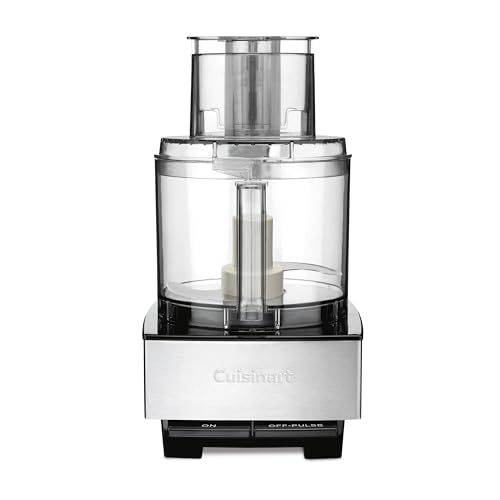
Best for: off-campus renters who cook for four or bake bread weekly Skip it if: you carry your kit between houses each term
This is the biggest, heaviest, most expensive pick here, and it earns those numbers on paper. The bowl is 14 cups, 5 more than the Ninja and 4 more than the Hamilton Beach 70730. The listing claims a limited 3-year warranty on the whole unit and a 5-year warranty on the motor, which is by a wide margin the longest published cover in this set. Cuisinart says the machine ships with a stainless slicing disc at 4mm, a medium shredding disc and a chopping and mixing blade, and the housing itself is stainless. The controls are on and off/pulse only, so there are no preset programs to lean on the way you can with the Ninja.
The real cost is physical. At 18 lb and 14.8 by 11 by 7.9 in, this is not a machine you move each time you cook. In a dorm it is impractical. In a shared apartment with a permanent counter spot, it becomes the appliance that survives the whole degree. The listing also notes the slicing and shredding blades are not adjustable, so cut thickness is fixed.
Pros:
- 14 cup bowl, the largest here
- Longest published warranty in the set on paper
- Stainless housing, not plastic
- Slice and shred discs included as standard
- Released 2018, so the design is proven
Cons:
- 18 lb, more than double most rivals here
- No preset programs, only on and pulse
- Fixed slicing thickness at 4mm
3. Hamilton Beach Food Processor 70730 — Best minimal setup
The 70730 gets a 10-cup bowl and slice and shred discs into a 6.2 lb body with two speeds plus pulse.

Best for: students who want slice and shred discs without a learning curve Skip it if: you would rather store one small chopper in a drawer
This is the middle-of-the-road pick and it makes no apology for it. Two speeds plus pulse, a 450 watt motor claim from Hamilton Beach, a 10 cup bowl and, unusually, a built-in bowl scraper that lets you move ingredients off the wall of the bowl while the machine is still running. That last feature reads like a gimmick and turns out to be the thing that separates it from the Ninja on paper: fewer preset programs, more manual control, one clever mechanical trick.
At 6.2 lb it is 1.45 lb lighter than the Ninja. Dimensions are 16 by 8.5 by 10 in, so it is taller and narrower on the counter, which suits a corner spot better than the Ninja's wider footprint. Warranty is 1 year, same as the Ninja. Where it loses is on quantitative headroom: the motor claim of 450 W is less than half the Ninja's peak claim, and there is no dough blade listed. If you never bake, that gap does not matter. If you do, the Ninja or the DFP-14BCNY are your two candidates.
Pros:
- Built-in bowl scraper, unique in this set
- 10 cup bowl in a 6.2 lb body
- Slice and shred disc included
- Two speeds plus pulse, easy to master
- Narrower footprint than the Ninja
Cons:
- No dough blade
- Motor claim is lower than the Ninja's
- No preset programs
4. Cuisinart Mini-Prep Plus — Best for pros
The DLC-2ABC is a 3-cup mini with a reversible chop and grind blade and the longest warranty of any pick under 4 cups.

Best for: culinary students who want a precise mini for herbs and grinding Skip it if: you plan to knead dough or slice a full onion at once
Two 3-cup picks made the shortlist and they are meaningfully different. The Cuisinart Mini pairs a 250 watt motor claim with what Cuisinart calls an auto-reversing SmartPower blade, which flips between a chop edge and a grind edge on the same blade. That grind side is the specific feature culinary students reach for: hard cheese, whole spices, nuts for pesto. The Hamilton Beach 72850G does not offer that reversal.
At 2.2 lb, 9.25 by 5 by 7 in, it stores anywhere. The listed warranty is 18 months, which is 6 months longer than the Ninja and the Hamilton Beach picks and the second-longest cover in the set after the DFP-14BCNY. The housing is BPA-free plastic in a brushed chrome finish. The trade-off is scale: 3 cups is 3 cups. You will refill it three times to prep a batch that the Ninja handles in one bowl, and there is no slice or shred function at all. This is a precision tool, not a workhorse.
Pros:
- Reversible chop and grind blade
- 18 month warranty, longer than most peers
- 2.2 lb, drawer-storable
- BPA-free bowl
- Purpose-built for herbs, cheese and nuts
Cons:
- 3 cup ceiling caps batch prep
- No slice, shred or dough function
- 250 W motor claim is the lowest here
5. Ganiza Food Processor with Dual Bowls — Runner-up
The Ganiza GC10-S is the only pick with two separate bowls in the box: an 8-cup glass bowl and an 8-cup stainless bowl.

Best for: students who want a second dedicated bowl for raw meat prep Skip it if: you need a published warranty on paper
The GC10-S earns its runner-up spot on one specific idea. Ganiza ships two bowls made of different materials: an 8-cup glass bowl and an 8-cup 304 stainless bowl, and the brand explicitly recommends keeping raw meat separate from vegetables between them. No other pick in this set does that. For a student who does meal prep with chicken or ground meat, that is a real hygiene answer and it saves buying a second appliance.
Two speeds, a full-copper motor Ganiza claims outlasts standard motors, and an overheat protection light on the housing round out the listed features. Dimensions are 13 by 8 by 7 in, so the footprint is smaller than the Ninja on paper. Here is where it loses ground: the listing does not publish a warranty term, which puts it behind every other pick here except in the specific case where the dual-bowl setup is what you actually need. Motor wattage is not stated in a comparable figure either.
Pros:
- Two 8 cup bowls, glass and stainless
- Overheat protection indicator on the listing
- Smaller footprint than the Ninja
- Full-copper motor claim from Ganiza
- Two-speed operation
Cons:
- No published warranty term
- Motor wattage not stated in a comparable figure
- Slowest seller of the six on this listing
6. Hamilton Beach 3 Cup Chopper — Best budget pick
The 72850G is a 2.1 lb chopper with a stack-and-press lid, dishwasher-safe parts and a 350 watt motor claim.
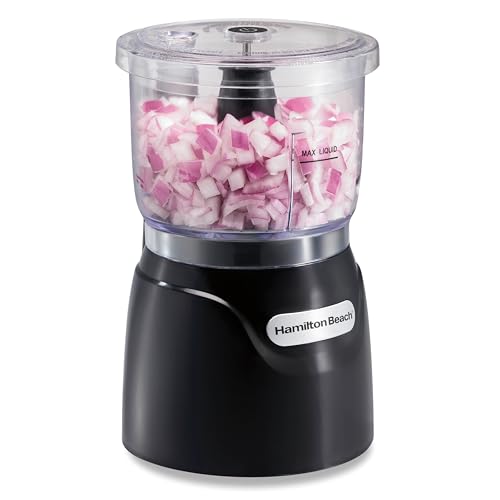
Best for: first-year students in a dorm with almost no storage Skip it if: you want to shred cheese or knead pizza dough
This is the smallest and lightest pick here at 2.1 lb, 8.54 by 5.9 by 5.2 in, and it is the one buyers choose most often across the six by a wide margin. The idea is simple: stack the ingredients, press the lid down to chop, release to stop. That is the whole interface. Hamilton Beach claims 350 watts, which is a hundred watts more than the Cuisinart Mini's motor claim, and the bowl, lid and removable blades are all listed as dishwasher-safe. Warranty is 1 year.
Compared against the Cuisinart Mini it is the more forgiving of the two: fewer moving parts, a lower price position, no reversible blade to think about. Compared against the Ninja and the DFP-14BCNY it does one job. There is no slicing disc, no shredding disc, no dough function, no preset program, no second speed. In a dorm room with a mini fridge and half a counter, that constraint is a feature, not a bug. In an apartment kitchen where you cook batches, you outgrow it inside a term.
Pros:
- 2.1 lb, lightest pick in the set
- Stack-and-press interface, no buttons
- Dishwasher-safe bowl, lid and blades
- Small enough for a drawer
- 350 W claim, higher than the Cuisinart Mini's
Cons:
- Chops only, no slice or shred
- 3 cup ceiling limits batch prep
- No dough capability
How much counter space will each one steal?
Footprint is the specification most guides ignore and the one that matters most in a shared kitchen. Here is what the listings publish, sorted from smallest to largest by longest dimension.
- Hamilton Beach 72850G: 8.54 x 5.9 x 5.2 in, 2.1 lb.
- Cuisinart Mini-Prep DLC-2ABC: 9.25 x 5 x 7 in, 2.2 lb.
- Ganiza GC10-S: 13 x 8 x 7 in.
- Cuisinart DFP-14BCNY: 14.8 x 11 x 7.9 in, 18 lb.
- Ninja BN601: 16 x 9.88 x 7.76 in, 7.65 lb.
- Hamilton Beach 70730: 16 x 8.5 x 10 in, 6.2 lb.
Two picks tie for the longest length at 16 in: the Ninja and the 70730. If your usable counter run is under that figure, you have three candidates left in the set, and only one of them, the Ganiza, has a bowl over 3 cups. That is a small field, and it is worth knowing before you shop.
Also worth noting: two of the picks are drawer-storable at close to 2 lb, but they are both 3 cup minis. There is no picking up a 10 cup machine each morning. Above 5 lb, a food processor becomes a permanent counter resident.
What the listings do not tell you about dorm use
The listings talk about capacity, motor claims and included discs. They do not tell you the four things that decide whether a food processor survives a student kitchen.
- Cord length. Not stated on any of these listings. Assume the plug will reach one outlet and plan the counter spot accordingly.
- Noise. Also not stated. Motors this size are loud enough to matter in a shared flat, particularly early morning meal prep.
- Parts availability. The Ninja and the two Cuisinart machines come from brands with wide replacement-parts networks in North America. The Ganiza does not publish that information on the listing.
- Halls and dorm rules. Some student residences ban appliances over a certain wattage. A 720 W claim on the DFP-14BCNY or a 1000 peak watt claim on the Ninja can cross that line where a 250 W Cuisinart Mini would not. Check the house rules before you order.
None of this is a reason to skip the category. It is a reason to keep the receipt for the first fortnight.
The verdict
The winner is the Ninja Professional Plus BN601. It is the pick that answers the most student kitchen questions in one 7.65 lb body: a 72 oz bowl for batch prep, four preset programs that shortcut the learning curve, and a dough blade for the one job most rivals here refuse to touch. Two conditions flip that recommendation. If your counter can host 18 lb permanently and you cook for four, buy the Cuisinart DFP-14BCNY: 14 cups, stainless housing, and the longest published warranty in the set on paper, with a 5-year motor cover. If your kitchen is a dorm room with a drawer, buy the Hamilton Beach 72850G: 2.1 lb, stack-and-press, dishwasher-safe parts, and no ambition beyond chopping. Between those extremes, the Hamilton Beach 70730 is a fair 10-cup middle at 6.2 lb, and the Ganiza GC10-S is the one to consider if the dual-bowl idea genuinely solves your hygiene problem. The Cuisinart Mini-Prep is a specialist, not a default. Buy it for herbs, cheese and spice grinding, not as a first food processor.
FAQ
Is a premium food processor worth it for a student?
A premium food processor is worth it when you cook batches, have counter space to concede, and expect to keep cooking at this scale after graduation. The Ninja BN601 makes the case at 72 oz and 7.65 lb. If any of those conditions fails, drop to a mid or entry pick, because the machine you leave in the cupboard is money spent on storage.
What is the best premium food processor for students in a small kitchen?
The best premium food processor for students in a small kitchen is the Ninja BN601, because its 7.65 lb weight and 16 in length are the manageable end of the premium band here. The Cuisinart DFP-14BCNY is the more capable machine on paper, but at 18 lb and 14.8 in deep, it needs a permanent counter home most rentals cannot spare.
Ninja BN601 or Cuisinart DFP-14BCNY: which wins on paper?
Ninja BN601 wins on footprint and preset programs; the Cuisinart DFP-14BCNY wins on capacity and warranty. Ninja gives you 72 oz, 7.65 lb, four Auto-iQ presets and a 1 year warranty. Cuisinart gives you 14 cups, 18 lb, no presets, and a claimed 3-year unit and 5-year motor warranty. Choose by counter space first.
Do I need a dough blade in a student food processor?
You need a dough blade only if you plan to make pizza, bread or pastry dough at home. Two picks here mention one: the Ninja BN601 lists a dedicated dough blade, and the Cuisinart DFP-14BCNY includes a chopping and mixing blade Cuisinart says handles dough. The other four picks in this roundup do not list dough capability at all.
What is the smallest premium food processor for students?
The smallest food processor here is the Hamilton Beach 72850G at 8.54 x 5.9 x 5.2 in and 2.1 lb, but it sits in the entry price band, not premium. Among premium-band picks in this set, the Ninja BN601 is the smaller of the two premium options at 7.65 lb, versus the Cuisinart DFP-14BCNY at 18 lb.
The right move is to measure the counter run you can actually spare, then check it against the six length figures in the footprint section above. If 16 in fits, the Ninja BN601 becomes the default: it does the most jobs of any pick here in the smallest premium-band body, and the four preset programs mean you spend the first term cooking, not reading the manual. If your counter is shorter than 16 in, the Hamilton Beach 72850G or the Cuisinart Mini-Prep step in, one for volume and simplicity, one for precision on herbs and grinding. Either way, the machine that lives out on the counter is the machine that gets used, and that is the real test.