Best Induction Rice Cooker for a One-Person Kitchen
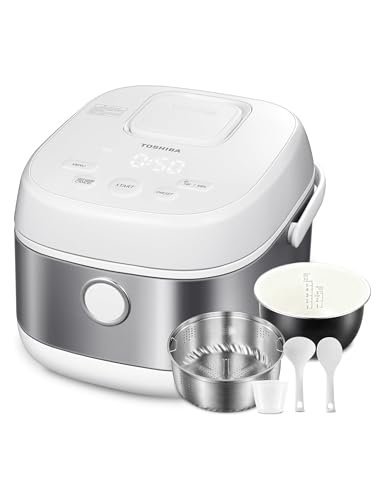
Five induction rice cookers, compared on the things that actually matter in a low-fuss kitchen: weight, control layout, cord design, capacity and cleaning. The Toshiba TRSH01 leads.

By Quinn BellUpdated 15 min read
On this page
- Best induction rice cooker for seniors at a glance
- Three reasons a cooker got cut
- Does the listing tell you it suits older hands?
- 1. TOSHIBA Rice Cooker Induction Heating — Best overall
- 2. Zojirushi Nw QAC10 5.5 Cup Induction Rice Cooker and Warmer — Best for beginners
- 3. Zojirushi NP-HCC10XH Induction Heating System Rice Cooker — Best premium
- 4. Oshenic Rice Cooker 20 Cup Cooked — Runner-up
- 5. AROMA Professional 6-Cups 360° Induction Rice Cooker & Multicooker — Best budget pick
- Weight, lid and cord: what to check before you buy
- How much rice does one or two people actually need?
- What more money buys across these five
- The verdict
- FAQ
The best induction rice cooker for seniors is the Toshiba TRSH01, because its eight named settings sit on one flat panel and its power cord detaches at the cooker, so the whole 10.5 lb unit never has to be dragged across a counter by the wire. If you want water measure lines printed inside the pot and a stated 2-year limited warranty, the Zojirushi NW-QAC10 is the better buy. This guide is not for someone cooking for six every night. That reader should look at 10-cup machines instead.
Best induction rice cooker for seniors at a glance
| Pick | Uncooked capacity | Weight | Price |
|---|---|---|---|
Best overall TOSHIBA Rice Cooker Induction Heating |
5.5 cups | 10.5 lb | Check Price |
Best for beginners Zojirushi NW-QAC10 Induction Rice Cooker |
5.5 cups | 10.8 lb | Check Price |
Best premium Zojirushi NP-HCC10XH Induction Heating System |
5.5 cups / 1.0 L | 9 lb | Check Price |
Runner-up Oshenic Rice Cooker 20 Cup Cooked |
10 cups | Not published | Check Price |
Best budget pick AROMA Professional 360° Induction Multicooker |
6 cups / 3 qt | 10.5 lb | Check Price |


Three reasons a cooker got cut
I started from the induction rice cookers listed under Small Appliances > Rice Cookers and cut hard. Three disqualifications did most of the work.
Cut one: no published weight or footprint. A cooker you cannot look up the weight of is a cooker you cannot plan a counter around. Two picks here still made the list despite thin specifications, and I say so in their sections, but any listing missing both weight and dimensions was dropped outright.
Cut two: no true induction heating. Plenty of digital cookers use a bottom hot plate and a fuzzy logic chip. Induction heating warms the inner pot itself, which is the whole reason this category exists. Every one of the five below states induction in the listing.
Cut three: capacity mismatched to the buyer. Machines above 10 cups uncooked went out. A bigger pot means a heavier pot and a taller lid swing.
What survived is five cookers spanning a wide price spread, four of them with published weights between 9 lb and 10.8 lb. That narrow weight range surprised me. Induction hardware carries a coil and a thick pot, and none of these five is light. Weight is not the differentiator I expected it to be. Control layout is.
Does the listing tell you it suits older hands?
No. Not one of these five listings makes a claim about older users, larger buttons, higher-contrast displays or grip-friendly handles. Amazon's search returns induction rice cookers when you ask for the best induction rice cooker for seniors, and the qualifier gets quietly ignored.
So treat that word as your job, not the manufacturer's. Nothing below is certified, labelled or marketed as senior-friendly, and I won't pretend otherwise. What I can do is line up the published specifications and the manufacturer's own descriptions and point at the ones that make daily use less of a chore.
Here is what carried real weight in the ranking:
- A detachable cord. Toshiba is the only pick whose listing names one. Every other cooker is a fixed-lead machine you unplug at the wall.
- Printed water lines inside the pot. Zojirushi says the NW-QAC10 has lines for every menu, including a half-cup white rice line.
- Named settings rather than a mode dial. Eight labelled functions beat one button you press repeatedly.
- A stated warranty. Only the NW-QAC10 publishes one: 2 years limited against defects in materials and workmanship.
- Total weight, because the pot comes out for washing. 9 lb to 10.8 lb across the four cookers that publish it.
1. TOSHIBA Rice Cooker Induction Heating — Best overall
The Toshiba TRSH01 pairs eight clearly named settings with a detachable power cord, and that combination is why it wins.
Best for: one or two people who want simple named settings and a cord that unplugs at the cooker Skip it if: you cook for a crowd and need more than 5.5 cups uncooked
The differentiator here is small and practical. Toshiba lists a detachable power cord as part of the safety package, alongside an automatic shut-off, a thermal fuse and a locking lid. None of the other four picks names a detachable cord. That matters when a 10.5 lb cooker has to move to the sink and back, because you disconnect at the appliance instead of tugging a lead out of a wall socket behind a toaster.
The menu is the other reason. Toshiba names all eight functions: Low Carb, Quick, White, Brown, Mixed Grain, Quinoa, Steam and Oatmeal. You read the label, you press it once. Capacity is 5.5 cups uncooked and 11 cups cooked, which suits a one or two person kitchen with leftovers.
The footprint is 8 x 11 x 10 in, the smallest published in this set. The inner pot is nonstick and Toshiba is explicit that it is hand-wash only, not dishwasher safe.
The trade-off against the two Zojirushi picks is documentation. Toshiba publishes no warranty term here, and no water measure lines are described.
Pros:
- Detachable power cord, the only one in this set
- Eight named cooking functions, no guesswork
- Smallest published footprint at 8 x 11 x 10 in
- Automatic shut-off, thermal fuse and locking lid
- Middle of the price range, not the top
Cons:
- No warranty term published in the listing
- Nonstick inner pot is hand-wash only
- 5.5 cups uncooked is too small for a large household
- No water measure lines described
2. Zojirushi Nw QAC10 5.5 Cup Induction Rice Cooker and Warmer — Best for beginners
The only pick in this set with a published warranty and printed water lines for every menu, including a half-cup rice line.

Best for: someone who wants water lines printed inside the pot and a written warranty Skip it if: counter space under a cabinet is tight
If measuring is the part of rice cooking that goes wrong, this is your machine. Zojirushi says the pot carries water measure lines for all menus plus dedicated lines for half a cup of white rice. That removes a step from the routine. Fill to the line, close the lid, press the menu. No side-cup, no arithmetic.
It is also the only cooker here with a stated warranty: 2 years limited against defects in materials and workmanship. Across a set of five induction machines, exactly one publishes a term, and that shifted my ranking.
The menu list Zojirushi describes runs white, quick white, mixed, sushi/sweet, Jasmine, quick Jasmine, congee, brown and GABA brown. A BPA-free steaming tray is included with an adjustable timer, and the pot has a double nonstick coating.
The cost is size and mass. At 9.7 x 14.2 x 12.5 in and 10.8 lb, it is the biggest and heaviest pick here, and the 12.5 in height is worth measuring against your cabinet clearance before you order. The lid still has to open under whatever hangs above it.
Pros:
- 2-year limited warranty, the only stated term here
- Water measure lines for all menus, plus a half-cup line
- Steaming tray and adjustable timer included
- Double nonstick coating for easier cleaning
Cons:
- Heaviest pick at 10.8 lb
- Tallest at 12.5 in, awkward under a low cabinet
- Sits in the upper price range of this set
- Only one seller lists it
3. Zojirushi NP-HCC10XH Induction Heating System Rice Cooker — Best premium
The lightest cooker in this set at 9 lb, with brown, GABA brown and germinated brown rice settings.

Best for: a daily rice eater who wants brown and GABA brown settings Skip it if: you want a menu list you can read at a glance
The number that stands out is 9 lb. That is 1.8 lb lighter than the NW-QAC10 and 1.5 lb under both the Toshiba and the AROMA. In a category where the whole cooker gets lifted to a sink, the lightest machine in the set is a genuine argument, and this is the most expensive pick here so I'd expect it to earn it somewhere.
Zojirushi rates it at 1,230 watts and lists a 1.0 L capacity, or 5.5 cups uncooked. The healthy grain options are the other draw: brown rice, GABA brown rice and germinated brown rice, all named settings. Automatic keep warm and extended keep warm hold cooked rice at serving temperature, and there are two delay timer settings.
Where it loses ground for this reader is the interface. Zojirushi describes "multi-menu cooking functions" without listing them all on the page, so the exact panel layout is less predictable than Toshiba's plainly enumerated eight. The listing also flags that sparks can appear at the plug when connecting or disconnecting, which is a normal characteristic of the electrical rating but not reassuring wording for a nervous user.
The footprint is 8 x 14 x 10 in, deeper than the Toshiba by 3 in.
Pros:
- Lightest published weight in this set at 9 lb
- Brown, GABA brown and germinated brown settings
- Extended keep warm plus two delay timer options
- 1,230-watt rating published
Cons:
- Highest price position of the five picks
- Full menu list not enumerated in the listing
- No warranty term published
- 14 in depth eats counter space
4. Oshenic Rice Cooker 20 Cup Cooked — Runner-up
Twice the capacity of the Zojirushi picks at the second-lowest price in this set, with eleven programs.

Best for: a household cooking large batches on a modest budget Skip it if: you want published weight and dimensions before you commit
Capacity is the whole story. Oshenic lists 10 cups uncooked and 20 cups cooked, which is roughly double the three 5.5-cup machines above. If rice gets cooked once and eaten across several days, or if a family visits at weekends, that changes the maths on which cooker fits your life.
Oshenic claims 1,050 watts and eleven programs: White Rice, Brown Rice, Sushi Rice, Clay Pot, Slow Cook, Steam, Soup, Congee, Quinoa, Reheat and Quick Cook. There is a 30-minute fast cook and a detachable steam cap, which is one fewer part to scrub around. The inner pot is stainless steel with multiple layers rather than nonstick-coated aluminium, and the brand describes it as a strong heat conductor.
Two things hold it back for this audience. First, the control panel is LCD touch. Touch panels have no travel and no click, so you get no physical confirmation that a press registered, and eleven programs on a flat surface is a lot to scan. Second, the listing publishes neither weight nor dimensions. A 10-cup induction cooker with a stainless pot will not be light, and you are buying without knowing the number.
It is also the slowest seller of the five.
Pros:
- Largest capacity here at 10 cups uncooked
- Eleven cooking programs including slow cook and soup
- Stainless steel multi-layer inner pot
- Detachable steam cap, fewer fixed parts to clean
Cons:
- No published weight or dimensions
- Flat LCD touch panel gives no press feedback
- Eleven programs is a busy menu to read
- Slowest seller of the five picks
- No warranty term published
5. AROMA Professional 6-Cups 360° Induction Rice Cooker & Multicooker — Best budget pick
The cheapest of the five, and the only one with a heat-retaining stainless steel lid and a 2 mm iron inner pot.

Best for: a spend-light kitchen that wants soup and porridge as well as rice Skip it if: you dislike touch-free-of-labels menus and want a stated warranty
This is the cheapest pick here and the only one that reads more like a multicooker than a rice cooker. AROMA lists White Rice, Multigrain, Steam, Oatmeal, Porridge and Soup functions across a 3-quart pot, which handles 6 cups uncooked and, by AROMA's description, 2 to 12 cups of cooked rice or grains.
The hardware description is more specific than most. AROMA describes 360° induction heating with dual temperature sensors and a heat-retaining stainless steel lid, plus a 2 mm thick heavy-duty iron inner pot with a nonstick coating. A thicker pot holds heat, which is the argument for iron over thin aluminium. The delay timer runs 15 hours, the longest published in this set after Toshiba's 24-hour timer.
The catch is what is not published. AROMA states 10.5 lb and a 3-quart size but gives no exterior dimensions, so counter fit is a guess. No warranty term appears either. The controls are described only as programmable digital controls, with no detail on button size, contrast or labelling.
Against the Toshiba, you trade a detachable cord, a full named menu and published dimensions for a lower price and a soup setting.
Pros:
- Cheapest of the five picks
- 2 mm iron inner pot with nonstick coating
- Dual temperature sensors and stainless steel lid
- Six functions including soup and porridge
- 15-hour delay timer
Cons:
- No exterior dimensions published
- No warranty term published
- Control panel detail is vague
- Fixed power cord, unlike the Toshiba
Weight, lid and cord: what to check before you buy
None of these listings answers the question you actually care about, so ask it yourself in this order. This is the checklist I'd run in a kitchen before ordering any of them.
- Measure your cabinet clearance. The NW-QAC10 stands 12.5 in tall and the lid opens above that. If you have 15 in under an upper cabinet, the cooker has to live somewhere else or come forward every time.
- Weigh what you already lift. The published weights run 9 lb to 10.8 lb. A full pot of cooked rice adds more. If a 9 lb kettle is already a two-hand job, the Zojirushi NP-HCC10XH is the lightest option here.
- Check the socket you'll use. Only the Toshiba names a detachable cord. Every other pick means reaching behind the counter to unplug.
- Look at how the pot comes out. All five use a removable inner pot. Toshiba and Zojirushi state nonstick coatings; Oshenic uses stainless steel, which tolerates firmer scrubbing but sticks more.
- Count the menu buttons you'd actually press. Eleven programs sound generous until you're squinting at a flat touch panel. Two or three named settings, used daily, beat eleven you never learn.
How much rice does one or two people actually need?
Most of this category is built around 5.5 cups uncooked, which is the standard Japanese household size. Three of these five picks land exactly there. That yields around 11 cups cooked, per Toshiba's own figure, which is a lot of rice for one person and a comfortable few days for two.
The two outliers pull in opposite directions. The AROMA holds 6 cups uncooked in a 3-quart pot. The Oshenic doubles the field at 10 cups uncooked, 20 cooked.
Bigger is not better here. A larger pot means more weight to carry to the sink and a wider lid to swing, and rice cookers cook small amounts less well when the pot is oversized. The half-cup water line Zojirushi prints inside the NW-QAC10 exists because tiny batches are exactly where these machines get finicky. If you cook one or two cups at a time, the 5.5-cup machines are the right shape for you.
What more money buys across these five
The spread here is wide, and what it buys is documentation more than hardware.
At the bottom, the AROMA gives you real induction heating, a 2 mm iron pot, six functions and a 15-hour timer. Nothing about the cooking is compromised. What's missing is published dimensions and any warranty term.
In the middle sits the Toshiba, and this is where the curve is steepest in your favour: eight named functions, a full 8 x 11 x 10 in footprint, a detachable cord, a 24-hour timer, and a documented safety package with automatic shut-off and a thermal fuse.
At the top, both Zojirushi machines. The NW-QAC10 buys you the water lines, the steaming tray and the 2-year limited warranty. The NP-HCC10XH buys the lightest body at 9 lb, a 1,230-watt rating and the germinated brown rice settings.
The honest summary: paying the most gets you better paperwork and specialist grain programs, not dramatically better rice.
The verdict
If you want one cooker that a person will still be using easily in three years, buy the Toshiba TRSH01. Eight settings you can read by name, a detachable cord so the wire is never the handle, the smallest footprint at 8 x 11 x 10 in, and a stated shut-off and thermal fuse. It sits mid-range on price, which means the money goes into the things you touch daily.
If measuring water is where the trouble starts, buy the Zojirushi NW-QAC10 instead. Its exact advantage over the Toshiba is printed inside the pot: water lines for every menu plus a dedicated half-cup white rice line, backed by the only published warranty here at 2 years limited. You pay more and you accept the largest body in the set at 10.8 lb and 12.5 in tall.
The cutoff is your cabinet clearance. Under 15 in of vertical space and the NW-QAC10 becomes a nuisance, which sends you back to the Toshiba at 10 in tall. Above that, and if measuring cups are the sticking point, the Zojirushi earns the difference.
Cooking for more than three people regularly? The Oshenic's 10 cups uncooked is the only pick in this set that covers you.
FAQ
Is the best induction rice cooker for seniors worth paying more for?
The best induction rice cooker for seniors is worth the step up mainly for interface and documentation, not cooking quality. The AROMA at the bottom of this set still uses real induction heating with dual sensors and a 2 mm iron pot. Paying more buys the Toshiba's detachable cord and named menu, or the Zojirushi's printed water lines and 2-year limited warranty.
Which is easier to use, the Toshiba TRSH01 or the Zojirushi NW-QAC10?
Easier to use depends on which step trips you up. The Toshiba wins on the panel and the cord: eight functions named in plain words, plus a cord that detaches at the cooker. The Zojirushi wins on measuring, with water lines for all menus and a half-cup white rice line. Choose Toshiba for controls, Zojirushi for filling.
How heavy are these induction rice cookers?
These induction rice cookers weigh between 9 lb and 10.8 lb where the figure is published. The Zojirushi NP-HCC10XH is lightest at 9 lb, the Toshiba and AROMA both sit at 10.5 lb, and the Zojirushi NW-QAC10 is heaviest at 10.8 lb. Oshenic publishes no weight, and a 10-cup stainless-pot machine will not be light.
Will an induction rice cooker fit under my kitchen cabinet?
An induction rice cooker will fit under most cabinets, but check the height first. The Toshiba stands 10 in tall in an 8 x 11 x 10 in footprint. The Zojirushi NW-QAC10 measures 9.7 x 14.2 x 12.5 in, so it needs real clearance for the lid to open. AROMA and Oshenic publish no exterior dimensions.
What mistake do first-time buyers make in this category?
First-time buyers make the mistake of counting menu programs. Eleven settings on a flat touch panel is harder to live with than five labelled buttons you press without thinking. The specifications that decide daily satisfaction are weight, lid height, cord type and whether water lines are printed inside the pot. Those rarely appear in the headline.
Start by measuring two things: the vertical gap above the counter where the cooker will live, and whether a 10 lb pot is comfortable to carry to the sink with both hands. Those two numbers narrow this set to one or two picks faster than any menu list will. For most one and two person kitchens, the Toshiba TRSH01 is the sensible default, because the features that make it easy are the ones you use every single day: a panel you can read, a cord that comes off, and a body small enough to leave out permanently.