Best Induction Rice Cooker for Large Families

A hard look at seven rice cookers, ranked for households that finish a full pot at dinner and want the next batch waiting warm.

By Quinn BellUpdated 17 min read
On this page
- The misconception about cup counts
- Best induction rice cooker for large families at a glance
- How I screened the field
- 1. Zojirushi NP-HCC10XH — Best overall
- 2. Aroma ARC-5000SB — Best upgrade
- 3. Cosori CRC-R501 — Best for pros
- 4. Toshiba TRSH01 — Best minimal setup
- 5. BLACK+DECKER RC516 — Best warranty
- 6. Aroma ARC-390NGP — Best budget pick
- 7. Zojirushi NP-GBC05XT — Most versatile
- Induction versus one-touch: what changes at family scale
- What more money actually buys
- How much rice does a large family really need?
- Which of these two should I buy?
- The verdict
- FAQ
The best induction rice cooker for large families is the Zojirushi NP-HCC10XH, a 5.5-cup uncooked machine that runs induction heating at 1,230W and holds finished rice at serving temperature through a long dinner window. If you routinely feed eight or more at one sitting, the Aroma ARC-5000SB steps up to a 10-cup uncooked pot with a slow cooker and steamer built in, though it is not an induction unit. Most guides treat cup counts as the whole story. They are not.
The misconception about cup counts
The obvious specification is raw cup capacity. Everyone leads with it, and it does matter: a 3-cup machine will not feed six people, and a 10-cup pot cooking two cups of rice tends to overcook the bottom layer. But it is not what decides a purchase for a large family.
The real deciding criterion is heating method plus keep-warm behaviour. Induction heats the entire inner pot at once through the metal itself. A conventional bottom-plate cooker warms from one surface, so a full family-sized pot cooks less evenly. That gap widens the more rice you load in. A large family cooking a full pot four nights a week feels it every time.
Keep-warm matters just as much. Rice cooked at 5 p.m. and eaten at 7 p.m. is common in a house with school pickups, sport and staggered dinners. A cooker that holds rice at a proper serving temperature without turning it yellow or dry is doing half the job.
The keyword modifier here, large families, is only partly served by the set. Amazon returned these seven when we searched for the best induction rice cooker for large families, but only four use induction heating. The other three are big conventional cookers that showed up because they are the biggest pots on the shelf. I have kept them in with clear labels, because for some households the extra raw capacity beats the heating method. Just judge that trade yourself.
Best induction rice cooker for large families at a glance
| Pick | Capacity | Heating | Price |
|---|---|---|---|
Best overall Zojirushi NP-HCC10XH |
5.5 cups uncooked | Induction, 1,230W | Check Price |
Best upgrade Aroma ARC-5000SB |
10 cups uncooked | Conventional, digital | Check Price |
Best for pros Cosori CRC-R501 |
10 cups cooked claim | Fuzzy logic, 1000W quick | Check Price |
Best minimal setup Toshiba TRSH01 |
5.5 cups uncooked | Induction, fuzzy logic | Check Price |
Best warranty BLACK+DECKER RC516 |
8 cups uncooked | Conventional one-touch | Check Price |
Best budget pick Aroma ARC-390NGP |
10 cups uncooked | Conventional one-touch | Check Price |
Most versatile Zojirushi NP-GBC05XT |
3 cups uncooked | Induction, 700W | Check Price |




How I screened the field
I started with every listing Amazon returned for the best induction rice cooker for large families and cut the field by three rules. Anything under 3 cups uncooked went out first: a large family cannot live on a small pot, no matter how clever the electronics. Anything without a clearly published capacity, weight or dimension went out second, because you cannot plan counter space around a maybe. Anything with obvious duplicate listings from the same brand went out third, so no two of these picks are the same appliance in a different colour.
What survived is what you see: four induction units and three conventional cookers that earn their place on raw capacity. I lined up the size and weight figures next to the feature bullets and looked for real differences.
- Two are true 5.5-cup induction pots from Japanese brands.
- One is a 3-cup induction pot small enough for a countertop but small at dinner.
- Three are conventional cookers with cooked-cup counts north of 15.
- One is a mid-priced multi-cooker with 18 claimed functions.
That mix answers different questions. A family of four wanting perfect rice reads differently from a family of eight cooking on a Sunday.
1. Zojirushi NP-HCC10XH — Best overall
A 5.5-cup induction cooker that gets the daily rice right and holds it warm through a two-hour dinner window.
Best for: families of four to six who eat rice most days and want the texture right every time Skip it if: you routinely cook for eight or more in one sitting
The NP-HCC10XH is the pick I would put in a house that eats rice more than three nights a week. It runs induction heating rated at 1,230W, so heat comes from the pot walls, not a hot plate underneath. The uncooked capacity is 1.0 L, or 5.5 cups. Zojirushi lists automatic keep-warm and extended keep-warm as separate settings, plus menu options for brown rice, GABA brown rice and germinated brown rice.
The body measures 8 x 14 x 10 in and weighs 9 lb, which is heavy for the counter but roughly average for the induction machines in this set. There is a delay timer with two settings, useful when a school pickup runs late. Compared to the two Aroma cookers here, the NP-HCC10XH cooks less rice per batch: 5.5 cups uncooked versus 10 cups. Compared to the Toshiba TRSH01, it matches on 5.5 cups but omits the low-carb function.
The trade-off is straightforward. It is the most expensive pick here, and it does not attempt to be a slow cooker, a steamer or a jambalaya pot. It cooks rice. It cooks rice well.
Pros:
- Induction heating rated at 1,230W
- Two keep-warm modes for staggered dinners
- Brown, GABA and germinated brown settings
- 5.5-cup capacity suits four to six eaters
- Delay timer with two presets
Cons:
- Most expensive pick here
- No steaming basket included
- 9 lb body is heavy to move
- No stated warranty in the listing
2. Aroma ARC-5000SB — Best upgrade
A 10-cup uncooked, 4-quart pot that also runs slow cook and steam programs from a digital panel.

Best for: big households wanting slow cooker and steamer duty from the same pot Skip it if: you need true induction heating
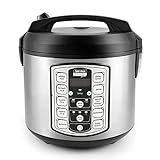
The ARC-5000SB is the biggest reasonable pot in this set. Aroma lists 10 cups uncooked, 20 cups cooked and a 4-quart working volume. Dimensions are 11.4 x 11.2 x 10.8 in, weight 8.6 lb, and it ships with a ceramic-coated inner pot, a steam tray, a measuring cup and a plastic spatula. The programmable digital panel handles rice, slow cook, steam and, per Aroma's bullets, cake.
For a household of six to ten, this is the practical upgrade. You cook the rice, stack the steam tray, and dinner and side arrive at the same time. Compared with the NP-HCC10XH, it holds nearly double the raw rice and adds a slow cooker mode the Zojirushi never attempts. Compared with the Cosori, it is simpler: fewer named programs, one clear job.
The honest cost is heat delivery. This is not an induction unit, and Aroma does not claim it is. On a full pot you will notice slightly less even cooking than on the Zojirushi. Aroma says the ceramic pot resists sticking, and the listing calls out a keep-warm switchover when cooking ends.
Pros:
- 10-cup uncooked capacity fits large families
- Slow cooker and steamer built in
- Digital panel with programmable timing
- Ceramic-coated inner pot
- Full accessory kit included
Cons:
- Not an induction cooker
- No warranty published in the listing
- 8.6 lb body needs dedicated counter space
- More buttons than a rice-only cook needs
3. Cosori CRC-R501 — Best for pros
Eighteen claimed programs across rice, oats, grains, steam and slow cook, with fuzzy logic and a 1000W quick setting.

Best for: cooks who juggle white rice, brown rice, oats and steamed vegetables in one week Skip it if: you want a simple two-button machine
The CRC-R501 is the busiest control panel in this roundup, and if you actually use the settings, it earns its position. Cosori lists 18 functions, including white and brown rice with texture options, three grain modes, three oat modes, steam, slow cook and sauté. The Quick Rice mode is rated at 1000W. The unit is 12.3 x 10.6 x 9.2 in and weighs 9.26 lb. Released in 2024. It carries a 2 Year Warranty in the listing.
Two things separate this from the Aromas. First, fuzzy logic: Cosori says the cooker adjusts a seven-step process to the load, which is closer to how the Zojirushi induction units behave than any conventional Aroma. Second, the ceramic inner pot and removable lid are dishwasher-safe per Cosori. That is the only listing here that promises that.
Trade-offs are real. It sits in the mid-price band, roughly between the entry Aromas and the premium Zojirushis, so you pay for the functions. If you cook rice and only rice, most of the panel goes unused. And the category path lists this as a commercial rice cooker, which is worth knowing for cabinet-sizing.
Pros:
- 18 claimed cooking functions
- Fuzzy logic on a 7-step process
- 2-year warranty published
- Dishwasher-safe pot and lid claim
- 24-hour keep warm and delay
Cons:
- Mid-priced, more than the Aromas
- Many programs a rice-only cook will not use
- Not sold as a true induction cooker
- Bigger footprint than the Zojirushi
4. Toshiba TRSH01 — Best minimal setup
A 5.5-cup induction cooker with a low-carb program aimed at households watching starch.
Best for: low-carb households cooking for four to six Skip it if: the low-carb setting is not on your list
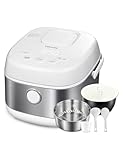
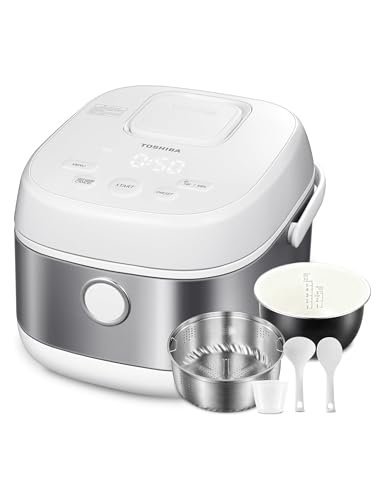
The TRSH01 is a close alternate to the Zojirushi. It matches on raw capacity, at 5.5 cups uncooked, and it uses induction heating with fuzzy logic per Toshiba's bullets. Eight menu options: Low Carb, Quick, White, Brown, Mixed Grain, Quinoa, Steam and Oatmeal. The 24-hour timer and automatic keep-warm cover late dinners. Dimensions are 8 x 11 x 10 in, weight 10.5 lb.
Toshiba describes the Low Carb function as reducing digestible starch and increasing resistant starch during cooking. That is the standout in this set: no other pick here lists a low-carb rice mode. A safety fuse, locking lid and detachable power cord are named in the listing, and the inner pot is hand-wash only.
The catch is the sales position. The Toshiba sells slower than the Cosori or the two Aromas in this set, and the offer count is 2, so shop the seller carefully. Against the Zojirushi, it adds the low-carb mode and quinoa program but does not name a wattage figure the way Zojirushi does. If the low-carb setting is not on your list, the Zojirushi is the more focused rice cooker.
Pros:
- Induction heating with fuzzy logic
- Low-carb rice mode
- Eight named cooking functions
- 24-hour timer with auto keep-warm
- Safety fuse and locking lid noted
Cons:
- Hand-wash pot only
- Heavier than the Zojirushi at 10.5 lb
- No published warranty in the listing
- Slower seller than the Cosori and Aromas
5. BLACK+DECKER RC516 — Best warranty
An 8-cup uncooked pot that comes with a 2-year limited manufacturer warranty and a steaming basket.

Best for: renters and first-apartment cooks who want a big pot and a safety net Skip it if: you want induction, not conventional heating
The RC516 is not an induction cooker. It earned its place in this roundup because it is the cheapest way to feed a large family with a machine that has a published warranty, and because it is the fastest seller of the seven. Capacity is 8 cups uncooked, yielding 16 cups cooked per BLACK+DECKER. Dimensions 9.25 x 11.5 x 11.5 in, weight 5 lb, model RC516X.
The warranty is what does the work here. It is a 2 Year Limited Manufacturer Warranty, matching the Cosori and unmatched by any Aroma or Zojirushi listing in this set. The nonstick bowl is dishwasher-safe per the listing, and the tempered glass lid has a hanger for spoon storage. Steaming basket, measuring cup and spoon are included.
The trade-off is direct. You lose induction heating, GABA and brown rice modes, and fuzzy logic. In exchange you get a lighter, cheaper pot with a real warranty. For a family that eats rice twice a week and wants a simple one-touch cook, that trade is fine.
Pros:
- 2-year limited manufacturer warranty
- One-touch, no programming curve
- Dishwasher-safe nonstick bowl
- Steaming basket included
- Lightest big-pot pick at 5 lb
Cons:
- No induction heating
- No brown or GABA rice program
- No delay timer
- Tempered glass lid can crack if dropped
6. Aroma ARC-390NGP — Best budget pick
A 10-cup uncooked pot with one-touch operation and a stack-inside steam tray.

Best for: a big weekly rice night on a tight budget Skip it if: you want programmable timing
The ARC-390NGP is the cheapest of the seven. It holds up to 10 cups of raw rice, per Aroma, which is the same nominal capacity as the ARC-5000SB above and roughly double the Zojirushi. Weight is 5.35 lb, and the bonus steam tray stacks inside for storage. One-touch operation, no digital panel, automatic keep-warm when cooking ends.
If your household finishes a full pot every Sunday, this is the practical choice. Aroma calls it a 5-quart pot suitable for families, and the design is deliberately simple: flip the switch, wait, serve. That simplicity is what separates it from the ARC-5000SB, which adds slow cook, steam and digital timing.
The compromises match the price. No delay timer, no low-carb setting, no brown rice program worth naming, and no published warranty in the listing. It is also a conventional cooker, so the same even-heat caveat applies as with the RC516 and ARC-5000SB. If you want programmable timing, step up to the ARC-5000SB. If you want induction, look at the Zojirushi or the Toshiba.
Pros:
- Cheapest of the seven
- 10-cup uncooked capacity
- Steam tray included
- Light at 5.35 lb
- One-touch simplicity
Cons:
- No delay timer
- No induction heating
- No published warranty
- No brown rice program
7. Zojirushi NP-GBC05XT — Most versatile
A 3-cup induction cooker for households that want Zojirushi quality without the counter space.

Best for: a couple or small family that wants Zojirushi quality without the big footprint Skip it if: you regularly feed more than four people
The NP-GBC05XT is the odd pick in a large-family roundup, and I have kept it in for one reason: some readers here are shopping for a second cooker to run alongside a bigger one, or they are a small family within a big extended household. Capacity is 0.54 L, or 3 cups uncooked, at 700W. Dimensions 7.5 x 11.8 x 9.13 in. It has menu options for white/mixed, sushi, porridge, brown, GABA brown, rinse-free and quick cooking, plus a rinse-free program the bigger Zojirushi does not name in its bullets.
The detachable inner lid washes separately, and it ships with a spatula, holder and measuring cup. Compared with the NP-HCC10XH, it swaps capacity for compactness: the same induction quality in roughly two-thirds the footprint. Compared with everything else here, it is undersized for a household of six.
The honest limit is right there in the numbers. Three cups of raw rice is dinner for three or four, not eight. For a large family, this is the sidecar cooker, not the main pot.
Pros:
- Zojirushi induction heating in a small body
- Seven menu options including rinse-free
- Detachable, washable inner lid
- Carrying handle and detachable cord
- Compact footprint
Cons:
- 3-cup capacity is small for a big family
- Slowest seller of the seven
- No warranty stated in the listing
- Hand wash only
Induction versus one-touch: what changes at family scale
Here is the trick with rice cookers at family scale. On a small pot cooking two cups of rice, the difference between induction and a conventional hot plate is real but forgivable. Load the same cooker to capacity and it matters much more. Conventional cookers push heat up through the base, so the rice at the bottom sees more energy than the rice at the top. Induction warms the pot itself, walls and all, so heat reaches the whole load at once.
That is why my top induction pick is a 5.5-cup pot, not a 10-cup one: at 5.5 cups uncooked, induction still hits every grain. The 10-cup Aroma and the 8-cup BLACK+DECKER handle bigger volumes, and they will feed more people per batch, but you trade heat evenness for raw capacity.
- If your priority is texture, pick induction and cook two batches on rice-heavy nights.
- If your priority is one big pot on the table, pick a 10-cup conventional cooker and accept slight bottom-to-top variation.
- If both priorities matter, run the Zojirushi as your daily driver and keep an Aroma or BLACK+DECKER in the cabinet for Sunday.
What more money actually buys
Across these seven, the price ladder tracks four things: heating method, program count, warranty and brand build quality. The two Aromas and the BLACK+DECKER sit in the entry band. The Cosori is mid. The two Zojirushis and the Toshiba are premium.
- Entry: one-touch operation, conventional heating, big pot, minimal or no published warranty.
- Mid: fuzzy logic, ceramic pot, 18 named programs, published 2-year warranty.
- Premium: induction heating, brown and GABA modes or a low-carb mode, tighter cooking control.
Extra money does not buy more capacity in this set. It buys better heat delivery and, in the Cosori's case, more programs. The largest pot here is a $-tier entry Aroma, not a premium unit.
How much rice does a large family really need?
A large family needs more raw capacity than a couple, obviously, but not as much as the biggest cookers suggest. As a rough planner, one uncooked cup yields two cooked cups, and one cooked cup is a generous side serving for one adult. A family of six eating rice as a side gets there on 3 to 4 uncooked cups. A family of six eating rice as the main dish, with a stew ladled over the top, needs closer to 5 or 6 uncooked cups.
Which is why the 5.5-cup Zojirushi covers most large families most nights, and the 10-cup Aromas earn their keep on the nights rice is the meal. If your household regularly seats eight or more, step up to the ARC-5000SB. If your household is four to six and rice is a side, the NP-HCC10XH is enough.
Which of these two should I buy?
Two picks cover the majority of readers here: the Zojirushi NP-HCC10XH and the Aroma ARC-5000SB. Choose between them on cooking method and function count, not capacity alone.
- Pick the Zojirushi if you cook rice more than three nights a week, if texture matters, and if the pot is only for rice.
- Pick the Aroma if you cook rice one to three nights a week, if the same pot also needs to slow-cook a stew or steam a fish, and if the household is six or more.
The Zojirushi is the more focused machine. The Aroma is the more flexible one. Neither answer is wrong; the mistake is buying the Zojirushi to slow-cook chili or buying the Aroma expecting Zojirushi-quality induction rice.
The verdict
For most large families shopping the best induction rice cooker for large families, the Zojirushi NP-HCC10XH is the right default. It is the induction-heated 5.5-cup pot that gets rice right on weeknights, holds it warm through a two-hour dinner window, and includes GABA and brown rice modes for the households that use them.
At the top end, the Aroma ARC-5000SB steps up when the seat count crosses six or seven at dinner. Ten cups of raw rice, a slow cook mode and a steam tray in the same 4-quart pot cover Sunday dinner in one appliance. It is not induction, and Aroma does not pretend it is, but the sheer capacity earns the spot.
At the entry end, the Aroma ARC-390NGP is the cheapest pot here that will still feed a big table. Below all of them for texture, but easy on the budget. The Cosori CRC-R501 wins if your kitchen genuinely runs 18 different programs a month, and the Toshiba TRSH01 is the induction pick for low-carb households. Each of the seven is right for someone. Match the pick to the plate count, then the cooking method, and you will not regret it.
FAQ
Is an induction rice cooker worth it for a family of six?
An induction rice cooker is worth it for a family of six if you cook rice more than three nights a week and care about even texture across a full pot. Induction heats the pot walls directly, so a 5.5-cup load cooks evenly top to bottom. If rice is a once-a-week side dish, a conventional 10-cup cooker like the Aroma ARC-390NGP is easier on the budget.
What size rice cooker do I need for a large family?
The size rice cooker you need depends on whether rice is a side or the main dish. As a side for six, 3 to 4 cups of raw rice is enough, so a 5.5-cup pot like the Zojirushi NP-HCC10XH handles it. As the main dish for six or more, step up to 8 to 10 cups uncooked with the BLACK+DECKER RC516 or the Aroma ARC-5000SB.
Zojirushi NP-HCC10XH versus Aroma ARC-5000SB: which is better?
Zojirushi NP-HCC10XH versus Aroma ARC-5000SB comes down to method versus capacity. The Zojirushi is induction, 5.5 cups uncooked, and rice-focused. The Aroma is conventional, 10 cups uncooked, and adds slow cook plus steam. For a rice-heavy household of four to six, the Zojirushi wins on texture. For a household of seven or more that wants one multi-purpose pot, the Aroma wins on utility.
Can I cook brown rice in these large-family rice cookers?
Cooking brown rice in these large-family cookers depends on the model. Both Zojirushis list dedicated brown rice and GABA brown rice programs. The Toshiba TRSH01 lists Brown and Mixed Grain. The Cosori CRC-R501 lists brown rice with texture options. The BLACK+DECKER RC516 and the two Aromas do not name a brown rice program, though they will still cook brown rice with the right water ratio.
What is the biggest mistake buying a rice cooker for a large family?
The biggest mistake buying a rice cooker for a large family is chasing the highest cup count without checking heating method. A 20-cup cooked pot sounds like the answer, but a conventional heater cooking a full load pushes uneven heat up from the base. A slightly smaller induction pot cooks more evenly. Match capacity to actual dinner volume, then choose the heating method, not the other way around.
Rice is the load-bearing carbohydrate in a lot of family dinners, and the pot you cook it in matters more than most kitchen buyers give it credit for. Start with the Zojirushi NP-HCC10XH if rice is a weeknight fixture, step up to the Aroma ARC-5000SB if the seat count climbs past six, and keep the BLACK+DECKER RC516 in mind as the safety-net pick with a real warranty. Whichever you choose, buy for the way your family actually eats, not the way the biggest cup number on the box suggests. The best induction rice cooker for large families is the one that finishes the pot evenly and keeps it warm until the last plate lands.