Best Ceramic Dutch Oven for Beginners: Overmont Wins

Five enameled cast iron Dutch ovens compared on capacity, weight and heat behaviour, so a first-time buyer can pick without guessing which size fits the shelf and the meal.

By Quinn BellUpdated 14 min read
On this page
- Best ceramic Dutch oven for beginners at a glance
- What actually decides a first Dutch oven
- How I cut a wider field down to five
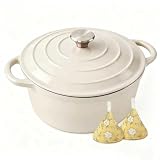
- 1. Overmont Enameled Cast Iron Dutch Oven — Best overall
- 2. Parmedu 5.5QT Enameled Cast Iron Dutch Oven for Sourdough — Most versatile
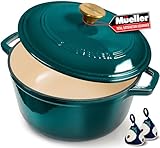
- 3. JANSKA Mueller DuraCast 6 Quart Enameled Cast Iron Dutch Oven — Best upgrade
- 4. Fijinhom 6 Quart Dutch Oven Pot with Lid — Best budget pick
- 5. JINCHUFURI 5 Qt Enameled Cast Iron Dutch Oven — Best minimal setup
- Is enameled cast iron really ceramic?
- How heavy is too heavy for a first pot?
- What size should a first Dutch oven be?
- Care mistakes that crack enamel early
- The verdict
- FAQ
The best ceramic Dutch oven for beginners is the Overmont Enameled Cast Iron Dutch Oven, a 7-quart pot with a self-basting lid and a triple-layer enamel interior that skips seasoning. If your kitchen is smaller or you cook for two to four, the 5.5-quart Parmedu is the friendlier size at a lower price position. Both are enameled cast iron, which is what most listings mean when they say "ceramic Dutch oven" for beginners.
Best ceramic Dutch oven for beginners at a glance
| Pick | Capacity | Weight | Price |
|---|---|---|---|
Best overall Overmont Enameled Cast Iron Dutch Oven |
7 QT | 15.2 lb | Check Price |
Most versatile Parmedu 5.5QT Enameled Cast Iron Dutch Oven |
5.5 QT | Not listed | Check Price |
Best upgrade JANSKA Mueller DuraCast 6 Quart |
6 QT | 12.5 lb | Check Price |
Best budget pick Fijinhom 6 Quart Dutch Oven Pot |
6 QT | 12.4 lb | Check Price |
Best minimal setup JINCHUFURI 5 Qt Enameled Cast Iron |
5 QT | Not listed | Check Price |



What actually decides a first Dutch oven
Most guides push you toward colour and brand history. That is not what decides it for someone buying their first ceramic Dutch oven. Two things do: the capacity relative to who you cook for, and the weight your wrists can lift out of a 500°F oven with padded mitts on.
Capacity is easy to get wrong high. A 7-quart pot sounds generous until you learn it weighs 15.2 lb empty. Add a 4 lb chuck roast and two quarts of stock, and you're moving nearly 25 lb across the kitchen. A 5-quart pot at a lighter build is often the better first buy, even if the recipe you saw on Instagram called for a bigger one.
The second thing beginners underestimate is the enamel. Every pot in this roundup uses enameled cast iron, which the category loosely calls "ceramic". The coatings resist rust and skip the seasoning ritual bare cast iron demands, but they chip if you slam a metal spoon against the rim or shock a hot pot with cold water. That is the real skill curve, not the cooking.
How I cut a wider field down to five
I started with the Dutch Ovens category and screened listings against three published constraints before anything else: enameled interior, oven-safe body, and a lid included in the sale. Bare cast iron got cut. So did pots sold without lids and any listing where the coating type wasn't stated.
From what remained, I cut on three more grounds:
- Missing structural specifications. If the listing didn't publish both capacity and dimensions, a beginner can't tell whether it fits their oven, so it was out.
- Overlapping size within a brand. Where a brand offered a 5-quart, 6-quart and 7-quart in the same line, I kept only the size that was best documented.
- No enamel-coating description at all. "Ceramic-look" without a coating description is a red flag for a first-time buyer.
Five pots survived: one 7-quart, one 6-quart at each of two price positions, one 5.5-quart, and one 5-quart. That range is deliberate. It lets me map picks to household size instead of to a single "winner takes all" verdict, which is what the best ceramic Dutch oven for beginners question actually needs.
1. Overmont Enameled Cast Iron Dutch Oven — Best overall
A 7-quart workhorse with the fullest published spec sheet in this set, including a stated 1-year warranty and a self-basting lid.
Best for: cooks feeding five to eight and baking large sourdough loaves Skip it if: you have a small oven or weak wrists
The Overmont is the only pot in this set that publishes every structural specification a beginner needs: 7 quart capacity, 15.2 lb weight, 12.6 x 11.8 x 11.8 in dimensions, and a 1-year manufacturer warranty. That transparency matters more than a marketing bullet. You can measure your oven cavity and your shelf before you buy.
Overmont says the lid uses "continuous condensation bumps" to redistribute steam back onto the food during braising, and describes the interior as a triple-layer enamel that requires no seasoning. Those are the manufacturer's claims, not measured performance, but they line up with what enameled cast iron generally does in this size class.
The trade-off is real. At 15.2 lb empty, this is the heaviest pot here, and it's the highest price position of the five. Beginners with wall ovens above waist height, or with any wrist issue, should size down. The 7-quart capacity is genuinely useful for weekend batch cooking and no-knead bread, but it is overkill for a two-person household and it will eat cabinet space.
Pros:
- Fullest published specification sheet in this set
- Stated 1-year manufacturer warranty
- 7 QT holds a 5-to-8 person meal
- Self-basting lid claim from Overmont
- Cream white finish reads as neutral on the table
Cons:
- Heaviest pot here at 15.2 lb empty
- Highest price position in the set
- 12.6 in outer width may crowd smaller ovens
2. Parmedu 5.5QT Enameled Cast Iron Dutch Oven for Sourdough — Most versatile
A mid-priced 5.5-quart pot the listing pitches explicitly at first-time bread bakers.

Best for: two-to-four person households who bake bread weekly Skip it if: you need published weight and warranty details before buying
The Parmedu sits in the useful middle of this set on both capacity and price position. At 5.5 QT it's large enough for a two-loaf batch of sourdough or a family stew, small enough to lift comfortably. Parmedu says the enamel is PFAS- and PFOA-free, and describes the pot as beginner-friendly for bread baking with a multi-layer enamel coating.
Here's the awkward part of the listing: the published dimensions read 0.39 x 0.39 x 0.39 in, which is clearly a data-entry error, and there's no weight or warranty on file. That's a documentation gap, not a product gap, but it forces a beginner to buy without knowing exactly how much shelf space the pot needs.
What the Parmedu does better than the two entry-priced pots is match its marketing to a real use case. If sourdough is the reason you're buying a Dutch oven at all, this size and the manufacturer's own bread-focused positioning line up. Against the Overmont, you lose two quarts of capacity and a warranty, and you gain a lighter pot and a lower price position.
Pros:
- 5.5 QT hits the sourdough sweet spot
- Cream white matches most kitchens
- PFAS- and PFOA-free claim from Parmedu
- Second-cheapest of the five
- Beginner-friendly positioning by the maker
Cons:
- Dimensions field appears to be a data error
- No published weight or warranty
- Fewer specifications than any other pick
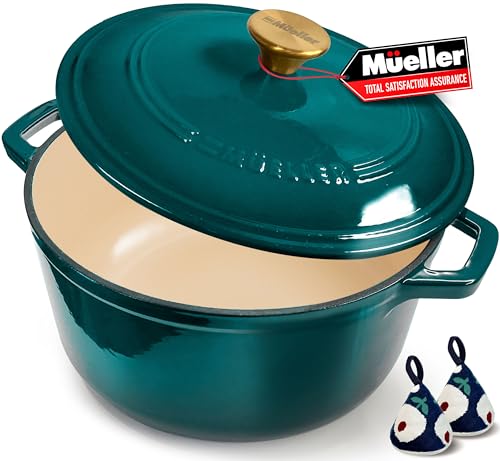
3. JANSKA Mueller DuraCast 6 Quart Enameled Cast Iron Dutch Oven — Best upgrade
A 6-quart, 12.5 lb pot with an oven-safe rating to 500°F and induction compatibility on the manufacturer's spec.
Best for: beginners who want a published warranty and induction compatibility Skip it if: cream white matches your kitchen better than emerald
The DuraCast pairs a 6 QT capacity with a 12.5 lb weight, which is the same weight class as the cheaper Fijinhom but with a stated manufacturer's warranty and the second-lowest sales rank of the five. Mueller says the porcelain enamel interior is non-stick through the glaze itself, contains no PFOA or PTFE, and that the pot is rated to 500°F for artisan bread and pizza.
The listing also claims compatibility across gas, electric, ceramic, halogen and induction cooktops. Any enameled cast iron pot is technically induction-ready because of the iron core, but having the maker state it protects you if the pot fails to trigger your hob. That is a real advantage for beginners who don't yet know the difference between the coating and the substrate.
Against the Overmont, you drop a quart of capacity and lose 2.7 lb of dead weight. Against the Parmedu, you gain a warranty and a full specification sheet. The trade-off is price position: the DuraCast sits in premium territory here. The emerald exterior is also a stronger visual statement than the three cream-white pots, which matters if the pot is going straight to the table.
Pros:
- Warranty stated on the listing
- 500°F oven-safe rating from Mueller
- 12.5 lb is lighter than the 7-quart pick
- Induction compatibility called out by the maker
- Second-cheapest to reach the shortlist by sales rank
Cons:
- Premium price position in this set
- Emerald finish won't suit every kitchen
- 13.3 in outer length needs oven-cavity measuring
4. Fijinhom 6 Quart Dutch Oven Pot with Lid — Best budget pick
The cheapest of the five, a 6-quart dark blue pot rated to 500°F on the listing.

Best for: first-time buyers who want a lower price and a bold colour Skip it if: you want a stated warranty in writing
The Fijinhom sits at the bottom of the price ladder here while still publishing the two figures a beginner needs most: 6 QT capacity and 12.4 lb weight. Dimensions are 4.7 x 10.2 x 10.2 in, which is a shallower profile than the DuraCast, useful information if your oven has short racks or you're storing the pot on a narrow shelf.
Fijinhom describes the interior as a non-stick coating over enameled cast iron and calls out compatibility with gas, electric, ceramic and induction stoves. The lid is described as a "circular shower design", which reads as marketing language for the same condensation-node feature the DuraCast and Overmont describe more clearly. The maker's own bullet, not verified performance.
The cons show up in what isn't there. Only one seller lists it, there is no warranty on the spec sheet, and the model number is listed as "1". None of that means the pot itself is worse in the kitchen. It does mean you have less recourse if a piece of enamel chips off the rim in month three. Against the DuraCast, you save on price and give up documentation.
Pros:
- Cheapest of the five
- 6 QT is the versatile middle capacity
- 12.4 lb is the lightest published weight here
- Induction, gas and electric compatibility stated
Cons:
- No warranty on the listing
- Only one seller stocks it
- Vague "model 1" documentation
5. JINCHUFURI 5 Qt Enameled Cast Iron Dutch Oven — Best minimal setup
The smallest capacity in the set, a 5-quart cream-white pot for one-to-four person cooking.

Best for: single cooks and couples with limited cabinet space Skip it if: you regularly cook for more than four
The JINCHUFURI is the pot to buy when the honest answer is that you cook for one or two people most nights. At 5 QT with 5.31 x 10.2 x 10.2 in dimensions, it fits smaller ovens and cabinets that a 7-quart pot would overwhelm. The maker says it is oven-safe to 500°F and compatible with gas, electric and induction cooktops, and describes the interior as a chip-resistant enamel.
The listing pitches the pot as serving four to six, which is optimistic for a 5-quart body once you factor in a lid clearance for bread baking. Treat it as a two-to-four serving pot and it does the job well: braises, small stews, a single boule of sourdough. Two adults eating leftovers Tuesday will not run out of pot.
Weight and warranty are both absent from the spec sheet, which is the main documentation trade-off against the DuraCast and Overmont. Model number FTJ-B02 at least gives you something to reference if you need to contact support. Against the Parmedu, you lose half a quart and gain full dimensions in a form you can actually measure.
Pros:
- Smallest footprint of the five
- 5 QT suits solo cooks and couples
- 500°F oven-safe rating from the maker
- Cream white finish reads as neutral
Cons:
- No published weight
- No stated warranty
- Optimistic four-to-six serving claim
Is enameled cast iron really ceramic?
Short answer: not chemically, but yes in the language every listing uses. Ceramic in the strict sense means a fired clay body. What Amazon calls a ceramic Dutch oven is almost always cast iron coated in a vitreous enamel, which is a glass-based coating fused to the metal at high temperature.
For a beginner buying their first pot, the distinction matters in exactly one place: heat behaviour. A true ceramic pot without a metal core is lighter, warms faster, and cannot go on induction. An enameled cast iron pot, like every one in this roundup, is heavier, holds heat longer, and works on every cooktop the maker states. That heat retention is what lets a Dutch oven hold a low braising temperature for hours without babysitting.
If a listing says "ceramic coating" and doesn't state the substrate, the substrate is almost always cast iron. If it says "100% ceramic", it is not. That is the check to run before buying.
How heavy is too heavy for a first pot?
Weight is the specification most first-time buyers ignore and most regret. Here is the range in this set, which covers most beginner listings:
- Fijinhom 6 QT: 12.4 lb
- JANSKA DuraCast 6 QT: 12.5 lb
- Overmont 7 QT: 15.2 lb
- Parmedu 5.5 QT and JINCHUFURI 5 QT: not listed
Add roughly 4 to 6 lb for a full pot of stew and you're carrying 17 to 21 lb from stovetop to oven, often at chest height, wearing mitts that dull your grip. That is the honest limit for many beginners. If any of that description sounds like a problem, size down to the 5 QT or 5.5 QT class. You lose one meal's worth of leftovers and gain a pot you'll actually take out of the cabinet.
The under-oven bake-and-transfer for sourdough is where weight bites hardest, because you're moving the pot preheated to 500°F. A lighter pot forgives more mistakes.
What size should a first Dutch oven be?
Match capacity to the number of people you cook for on a typical Sunday, not the biggest meal you might one day host.
- 1 to 2 people: 5 QT. The JINCHUFURI fits here.
- 2 to 4 people: 5.5 to 6 QT. Parmedu, Fijinhom or the DuraCast.
- 4 to 6 people or a bread-and-braise habit: 6 QT with a wider profile. The DuraCast.
- 5 to 8 people, holidays, batch cooking: 7 QT. The Overmont.
The trap is buying the biggest pot for the one-off dinner party and lifting a 15 lb body twice a week for the rest of the year. A Dutch oven that stays in the cupboard because it's too heavy is a worse pot than a 5 QT you actually use.
Care mistakes that crack enamel early
Enameled cast iron is durable, not indestructible. Four habits shorten its life:
- Metal utensils on the interior. Wood, silicone or nylon only. A metal spoon dragged across the base chips the glaze.
- Thermal shock. Do not pour cold water into a hot pot, and do not put a hot pot on a cold, wet counter. The temperature gradient can crack the enamel.
- Empty preheats above medium. Dry heat with nothing in the pot stresses the coating. Preheat with oil or water.
- Abrasive scrubbers. Soak in warm water first, then use a soft sponge. Every listing in this set calls out easy cleanup, and every one of them assumes you're not attacking it with steel wool.
None of the five pots publishes a formal care standard, so treat all of them the same way. That habit is the single biggest predictor of whether your first Dutch oven lasts a year or a decade.
The verdict
The Overmont Enameled Cast Iron Dutch Oven is the best ceramic Dutch oven for beginners in this set because it publishes the fullest specification sheet, states a 1-year warranty, and delivers 7 QT of capacity with a self-basting lid Overmont describes in detail. It is the pot to buy when your household is four or larger and you already know sourdough is on the agenda.
Two conditions flip the pick. If you cook for two to four and want a lower price position, the Parmedu 5.5 QT is the more sensible size, particularly for weekly bread baking. If you want a published warranty on a lighter body and cook on induction, the JANSKA Mueller DuraCast 6 Quart is the upgrade, with the emerald finish as a bonus if you like the look.
The Fijinhom 6 QT earns its place as the cheapest way into the category, and the JINCHUFURI 5 QT is the honest answer for solo cooks and couples. Skip either only if a stated warranty is a hard requirement. Whichever you pick, buy for the meals you cook weekly, not the meals you might cook once.
FAQ
Is a ceramic Dutch oven the same as an enameled cast iron pot?
A ceramic Dutch oven, in Amazon's category language, is almost always an enameled cast iron pot with a glass-based coating fused to the iron body. Every pick here fits that description. A true ceramic pot without a metal core exists, but it cannot be used on induction and is rarer at this price. Check the listing for a stated cast iron substrate before you buy.
Is a 7-quart Dutch oven worth it for a beginner?
A 7-quart Dutch oven is worth it for a beginner only if you cook for five or more people regularly or bake large sourdough loaves. The Overmont weighs 15.2 lb empty, so you are lifting 20 lb or more once it's full. For a household of two to four, a 5.5 QT or 6 QT pot is lighter, cheaper, and easier to store.
Can these Dutch ovens go on an induction cooktop?
Yes, every pot in this roundup can go on an induction cooktop because enameled cast iron has the iron core induction hobs need. The JANSKA DuraCast, Fijinhom and JINCHUFURI listings state induction compatibility explicitly. The Overmont and Parmedu don't call it out but use the same substrate. If your hob is fussy, pick a pot where the maker states induction on the spec sheet.
Overmont or JANSKA DuraCast: which is the better first pot?
Between the Overmont and the JANSKA Mueller DuraCast, the DuraCast is the better first pot for most beginners: it weighs 12.5 lb against the Overmont's 15.2 lb, includes a stated warranty, and its 6 QT capacity suits a wider range of households. The Overmont wins only when you truly need 7 QT for batch cooking or family meals of five to eight people.
What's the biggest mistake beginners make with a ceramic Dutch oven?
The biggest mistake beginners make with a ceramic Dutch oven is thermal shock: pouring cold water into a hot pot, or setting a hot pot on a cold, wet surface. Both can crack the enamel. Metal utensils, empty high-heat preheats, and abrasive scrubbers do slower damage. Wood or silicone tools, gradual temperature changes, and a soft sponge keep the coating intact for years.
A first Dutch oven is a ten-year purchase if you treat it right, so buy for the meals you actually cook this month, not the one you imagine hosting next December. Measure your oven cavity and your cabinet shelf before you order, weigh the pot honestly against your wrists, and match the capacity to the household you feed on a typical Tuesday. The Overmont wins this roundup because it publishes the numbers a beginner needs and holds enough food for five to eight, but its 15.2 lb body is a real commitment. If any part of that gives you pause, size down to the DuraCast or the Parmedu and cook more often.